Most voice AI projects do not fail because the technology is weak. They fail because the rollout is careless. An AI voice receptionist in Dubai lives or dies on integration, trust, and language handling, not on the underlying model. Get those right and the agent performs. Get them wrong and it becomes an expensive experiment.
This is a practical field guide. It names the real obstacles Dubai firms hit and shows how to clear each one, drawn from how AI actually gets deployed across the GCC.
Key Takeaways
GCC adoption is high at 84%, but only 31% have fully scaled AI, and the gap is usually rollout discipline (McKinsey, 2025).
The hardest problems are integration, accuracy, trust, and bilingual handling, not the AI itself.
Start narrow with overflow calls, measure, then expand to protect trust and prove value.
A custom agent tied to your real systems avoids the failure mode of generic bots.
Why Do Voice AI Projects Actually Fail?
Voice AI projects fail mostly at rollout, not at the model, and the GCC data shows the pattern: 84% of organizations have adopted AI while only 31% have scaled it (McKinsey, 2025). The distance between a pilot and a working deployment is where projects die.
The usual causes are predictable. The agent is not connected to the real calendar or CRM, so it takes messages instead of booking. Its knowledge base is stale, so it gives wrong answers about pricing or hours. It is switched to primary answering on day one, before anyone trusts it, so the first error becomes a reason to abandon it.
None of these are AI problems. They are project-management problems. A voice agent is only as good as the systems it connects to and the discipline of its rollout. Firms that treat it as a plug-and-play gadget get plug-and-play results. Firms that treat it as an operations change get an operations improvement.
How Do You Solve the Integration Problem?
You solve integration by connecting the agent to your live calendar, CRM, and knowledge base before it ever takes a call, so conversations end in booked outcomes rather than messages. Integration is the single biggest predictor of whether an agent adds value or just noise.
A message-taking bot creates work: someone still has to read the message, call back, and book. That is a half-solution that often makes the front desk busier, not calmer. A properly integrated agent writes the booking directly, updates the record, and confirms to the caller inside the same call. The loop closes without human touch.
For a Dubai firm, integration also means respecting the tools you already run. The agent should fit your existing calendar and CRM rather than forcing a rip-and-replace. A custom build does this by design, because it is shaped around your stack instead of a generic template. That is the difference between an agent that ships and one that stalls in a pilot.
Our finding: The clearest early warning sign of a failing voice project is an agent that only takes messages. If it cannot book, it has not been integrated, and it will not deliver ROI.
How Do You Keep the Agent Accurate?
You keep the agent accurate by feeding it from a single controlled knowledge base and updating that one source whenever the business changes. Accuracy is a maintenance habit, not a one-time setup, and it is where trust is won or lost.
The failure pattern is a knowledge base that ages. Prices change, hours shift, a service is added, but the agent still quotes the old facts. Callers notice, staff lose confidence, and the agent gets sidelined. The fix is structural: one source of truth that the agent reads from, updated the moment anything changes.
Build a light review rhythm into the rollout. In the first month, read transcripts weekly and correct any point where the agent stumbled or guessed. After that, update the knowledge base whenever a real fact changes. This keeps the agent's answers current without constant oversight, and it turns accuracy from a worry into a routine.
How Do You Handle Arabic and English Without Breaking the Call?
You handle both languages by choosing an agent built for bilingual conversation from the start, so it can switch mid-call without forcing the caller to repeat themselves. In Dubai, this is not an edge case. It is the default caller behavior.
A caller may open in Arabic, ask a detailed question in English, then confirm in Arabic. An agent that cannot follow this creates friction, and friction ends bookings. The solution is to specify bilingual handling as a core requirement, not an afterthought, and to test it against real call patterns before going live.
Language also shapes trust. A caller who is met in their preferred language feels the business is organized and respectful. A caller who has to restart or repeat feels the opposite. For a Dubai deployment, smooth Arabic and English switching is one of the highest-impact details you can get right.
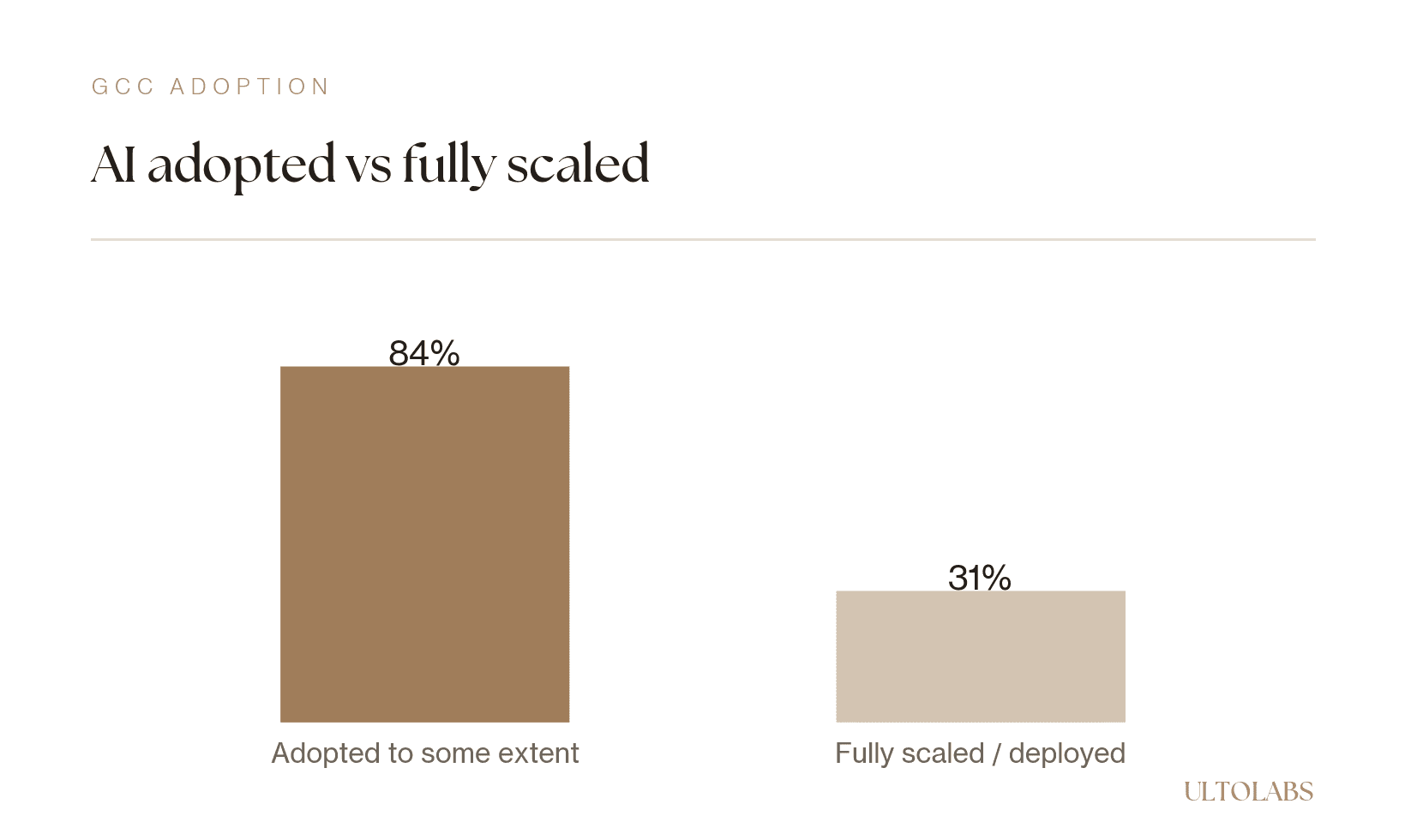
The adoption-to-scale gap in the GCC (McKinsey, 2025).
What Does a Low-Risk Rollout Look Like?
A low-risk rollout starts the agent on overflow and after-hours calls, measures its accuracy, then widens its scope only once it earns trust. This staging is how the 84% who adopt become the 31% who scale (McKinsey, 2025). It removes the all-or-nothing bet that sinks careless projects.
Phase one is pure upside: the agent catches calls the team would otherwise miss. No one loses work, and every booking is found revenue. Phase two adds daytime overflow once the agent proves it books and routes correctly. Phase three moves defined call types to primary answering, with humans handling the exceptions.
Trust builds at each step because staff and customers see the agent perform before it takes on more. Measurement runs throughout: answer rate, booking rate, and routing accuracy. When a number lags, you fix the cause before widening scope. This is unglamorous and it is exactly why it works.
Unique insight: The firms that scale voice AI are rarely the ones with the best technology. They are the ones with the most patient rollout. Restraint early is what earns the right to expand.
Frequently Asked Questions
How long does a voice AI deployment take in Dubai?
A focused rollout covering after-hours and overflow can go live quickly, then expand as it proves accuracy. The timeline depends mainly on how many systems it connects to and how specific your call and booking rules are, not on the AI itself.
What if my team resists the change?
Resistance usually fades when the agent starts on calls the team was already missing, so no one loses work. As it proves itself on overflow, staff typically welcome the reduced interruptions and cleaner handoffs. Start narrow to build buy-in.
Do I need to replace my current phone system?
Usually not. A custom agent is built to fit your existing setup and connect to the calendar and CRM you already use. The goal is to add answering capacity, not to force a costly rip-and-replace.
How do I know it is working?
Track answer rate, booking rate, and routing accuracy from launch. These three numbers show whether the agent is capturing calls, closing bookings, and handing off correctly. If any lags, it points you straight to the fix.
Conclusion
Voice AI in Dubai does not fail on technology. It fails on integration, accuracy, trust, and language, all of which are within your control. Connect the agent to real systems, feed it from one current source of truth, handle Arabic and English properly, and roll out in stages that earn trust. Do that and the agent moves from pilot to performer.
UltoVoice is built as a custom deployment, shaped around your stack and your call patterns, so it ships and performs rather than stalling. Start narrow, measure, and expand with confidence.
Sources: McKinsey, The state of AI in GCC countries, retrieved 2026-07-10.