Every unanswered call is a customer handing your competitor a decision. Across the Middle East, firms spend heavily to make the phone ring, then lose the caller in the last three seconds because no one picks up. A custom AI voice receptionist closes that gap. It answers on the first ring, every hour, in the languages your market speaks.
This guide is written for owners and operators who treat the phone as a revenue channel, not a cost center. It covers what a custom AI voice receptionist for business actually does, why the economics favor it, and how to deploy one without disrupting the team you already have.
Key Takeaways Roughly 62% of business calls go unanswered, and about 85% of callers who reach voicemail never call back, according to widely cited call-analytics research (Invoca and BIA/Kelsey). A custom AI voice receptionist answers every call instantly, books appointments, and routes urgent cases, so no lead falls through. GCC organizations are moving fast: 84% report having adopted AI to some extent (McKinsey, 2025). Custom beats off-the-shelf when your calls involve your pricing, your booking system, and your service rules.
What Is a Custom AI Voice Receptionist for Business?
A custom AI voice receptionist is a voice agent trained on your business that answers calls, holds a natural conversation, and completes tasks like booking, qualifying, and routing. Unlike a generic phone menu, it understands intent, speaks in full sentences, and works from your actual data. In 2026, GCC firms are adopting this class of tool quickly, with 86% of surveyed organizations already using AI agents in daily workflows versus 69% globally (McKinsey, 2025).
The difference sits in the word "custom." A stock answering bot reads a script. A custom agent knows that your clinic closes at 9pm, that your quotation for a 200-square-meter fit-out starts at a specific figure, and that a caller asking about an existing order should be routed to operations. It connects to your calendar, your CRM, and your knowledge base, so the conversation ends in a booked slot rather than a promise to call back.
According to McKinsey's 2025 GCC research, 84% of organizations in the region have adopted AI to some degree, yet only 31% have scaled it across the business. That gap is the opportunity. The front desk is one of the highest-return places to start, because the phone is where demand either converts or disappears.
UltoVoice is built for this exact job: a receptionist that sounds like your brand, runs on usage-based pricing plus a setup fee, and handles the calls your team cannot always reach.
Why Do So Many Business Calls Go Unanswered?
Most calls go unanswered because staff are busy, off shift, or overwhelmed at peak times, and the numbers are stark: research widely cited across the industry puts unanswered business calls near 62%, with about 85% of voicemail-reaching callers never trying again (Invoca; BIA/Kelsey). Each of those calls was demand you already paid to create.
The cost is not abstract. A missed call is a lost booking, a lost quote, and often a lost lifetime customer. Buyers rarely wait. When your line rings out, the next result in the search list gets the call. In service industries the caller frequently has urgent intent, which means the abandonment rate climbs higher, not lower.
Peak times make this worse. Your busiest hour on the shop floor is often your busiest hour on the phone, and that is precisely when reception is least able to answer. Nights, weekends, and public holidays add another layer of silence. A human team cannot cover every hour without expensive shift work. A voice agent covers all of them at a fraction of the cost.
Our observation: In most audits we run for Middle East firms, the biggest leak is not the marketing budget. It is the calls that budget generates and the front desk cannot catch.
How Does an AI Voice Assistant Protect Revenue?
An AI voice assistant protects revenue by converting answered calls into booked outcomes instead of missed opportunities. With unanswered rates near 62% across businesses (Invoca), even recovering half of lost calls moves the top line. The agent answers instantly, so the caller never reaches the point where they hang up and dial a competitor.
Speed to answer is the first lever. Every second on hold raises abandonment. A voice agent has no queue and no lunch break, so the first ring is the last ring. The second lever is completion. A human might promise a callback that never happens. The agent books the appointment inside the same call, writes it to your calendar, and confirms by message.
The third lever is consistency. People have good days and bad days. The agent asks the same qualifying questions every time, captures the same details, and never forgets to log the lead. That consistency is what turns a noisy phone line into a clean, measurable pipeline.
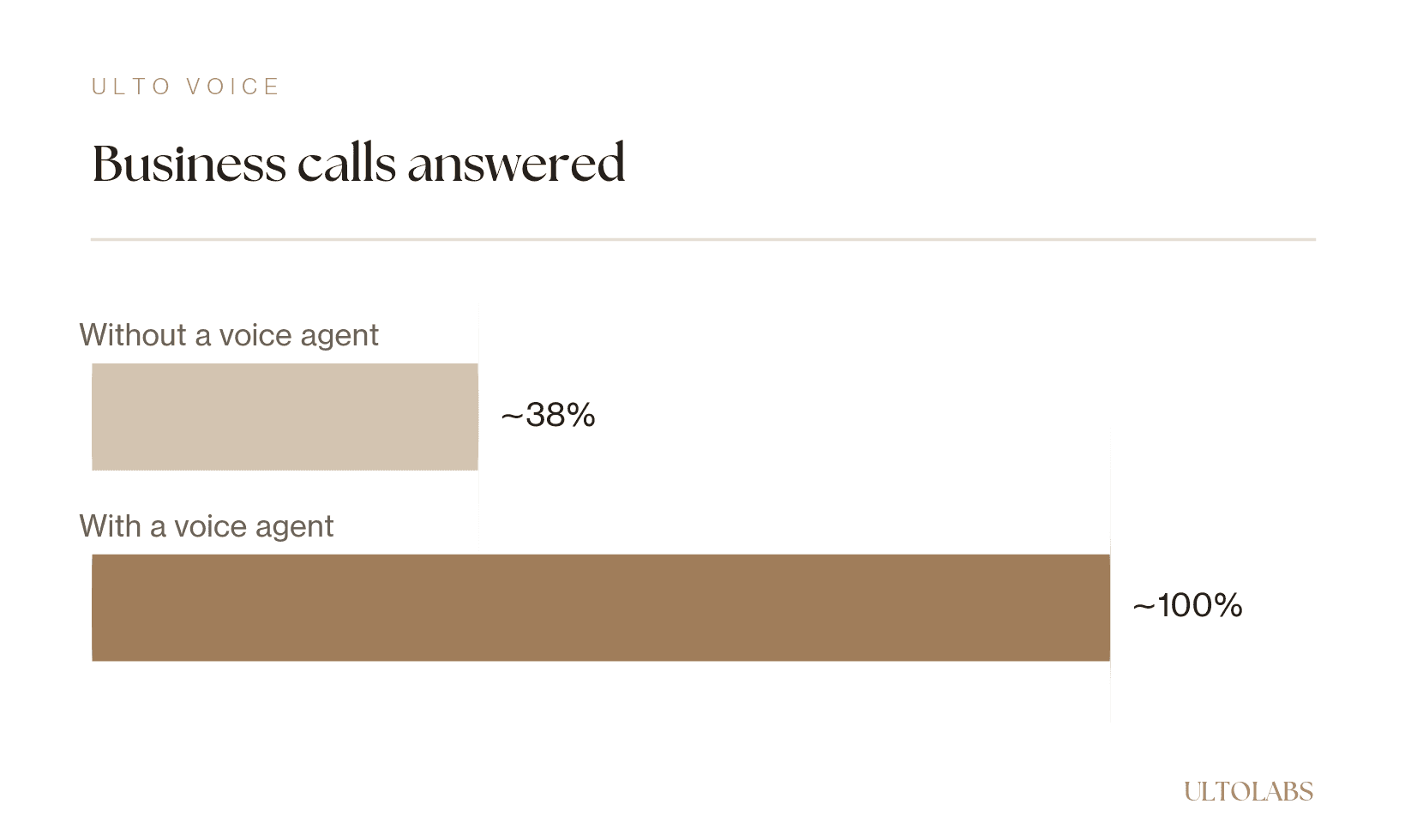
Illustrative comparison based on widely cited call-handling research (Invoca; BIA/Kelsey).
What Can a Custom Voice Agent Actually Do on a Call?
A custom voice agent handles the full front-desk job: it greets, answers questions, qualifies, books, and routes, all in one call. In 2026, McKinsey reports 86% of GCC organizations already run AI agents in daily workflows (McKinsey, 2025), and voice is one of the most common entry points.
Here is the practical scope of a well-built agent:
Answer every inbound call instantly, in Arabic, English, or both, with no hold time.
Book, reschedule, or cancel appointments directly in your calendar.
Qualify leads with your questions, then write the record to your CRM.
Answer common questions about hours, location, pricing bands, and services.
Route urgent or complex cases to the right person, with context attached.
Send a follow-up confirmation by WhatsApp or SMS after the call ends.
The agent does not replace judgment. It handles the volume of repeatable calls so your team spends its time on the conversations that need a human. That division of labor is where the value sits. Your specialists stop acting as a switchboard and start closing.
Custom AI Voice Receptionist vs. Off-the-Shelf Bots
A custom AI voice receptionist wins when calls touch your pricing, your systems, and your rules, because a generic bot cannot know any of them. Off-the-shelf tools are cheap to start and quick to disappoint, since they read a fixed script and break the moment a caller asks something specific.
The difference shows up in three places. First, integration: a custom agent writes to your calendar and CRM, while a stock bot usually just takes a message. Second, accuracy: a custom agent quotes your real service bands and booking rules, while a generic one guesses or deflects. Third, brand: a custom agent speaks in your tone and your languages, while a template sounds like a template.
For a small business with simple needs, a stock tool may be enough. For a growing firm where each call can be worth hundreds or thousands, the margin for error is small. That is when custom pays for itself, because one correctly captured high-value lead often covers months of cost.
Unique insight: The right question is not "human or AI." It is "which calls need a human, and which are pure volume." A custom agent lets you draw that line deliberately instead of losing calls by accident.
How Do You Deploy a Voice Agent Without Disrupting the Team?
You deploy a voice agent by starting narrow, measuring, then widening its scope, so the team adapts instead of resisting. GCC firms that scale AI successfully tend to be deliberate: only 31% have reached full deployment despite 84% adoption (McKinsey, 2025), and the gap is usually about rollout discipline, not technology.
A clean rollout looks like this. Begin with overflow and after-hours calls, where the agent only catches what the team would otherwise miss. Nobody loses work, and every captured lead is pure upside. Once the agent proves it books accurately and routes well, expand it to daytime overflow and then to primary answering for defined call types.
Measurement runs alongside. Track answer rate, booking rate, and routing accuracy from day one. Review transcripts weekly in the first month, correct the agent's knowledge where it stumbled, and tighten the routing rules. Within a few weeks the agent handles the repeatable volume and your team notices the quiet: fewer interruptions, cleaner handoffs, and a booking list that fills itself.
Frequently Asked Questions
Can an AI voice receptionist speak Arabic and English?
Yes. A custom agent can hold natural conversations in Arabic, English, or both, and switch based on the caller. This matters across the Middle East, where a single business line often serves callers who start in one language and continue in another within the same call.
Will callers know they are speaking to an AI?
They can, and transparency is the honest default. In practice, callers care less about who answers and more about whether their problem gets solved. A well-built agent that books the appointment and answers the question earns satisfaction rates comparable to human reception in recent industry testing.
Does it replace my receptionist?
No. It removes the repeatable, high-volume calls that pull staff away from higher-value work, and it covers the hours no human can. Your team keeps the conversations that need judgment and relationship, while the agent catches the rest.
How long does setup take?
A focused deployment covering after-hours and overflow can go live quickly, then expand as it proves accuracy. The pace depends on how many systems it connects to and how specific your call rules are.
Conclusion
The phone is still where demand converts, and in most Middle East firms it is also where demand quietly leaks. With roughly 62% of business calls unanswered and most voicemail callers gone for good, the front desk is the highest-return place to deploy AI. A custom AI voice receptionist answers every call, books the outcome, and hands your team only the conversations that need them.
UltoVoice is built to do exactly that, tuned to your brand, your systems, and the languages your market speaks. Start with the calls you are already missing, measure what comes back, and expand from there.
Sources: McKinsey, The state of AI in GCC countries (retrieved 2026-07-10). Call-handling figures reflect widely cited research from Invoca and BIA/Kelsey.