Most firms treat the phone as overhead. It is closer to a leaking pipe with money running out of it. Every missed call is paid-for demand that reaches a competitor instead of you. An AI answering service for businesses turns that leak into recovered revenue, and the math is rarely close.
This post is the financial case. No vague promises, just the levers that move the return: recovered calls, lower cost per answered call, and faster conversion.
Key Takeaways
Small businesses lose an estimated $126,000 a year to missed calls, and around $450 per missed call in some analyses (widely cited missed-call research, 2025).
An AI answering service recovers those calls at a fraction of the cost of round-the-clock staff.
Forrester's Total Economic Impact study documented a 248% three-year ROI for enterprises deploying automation platforms (Forrester TEI, 2024).
The return comes from three levers: more calls answered, lower cost per call, and faster booking.
What Does a Missed Call Actually Cost?
A missed call costs far more than a moment of silence, because it represents demand you already paid to generate and a customer who rarely tries twice. Analyses widely cited across the industry put the loss near $450 per missed call and roughly $126,000 a year for a typical small business (2025 missed-call research). Those figures are the starting point for any ROI calculation.
The cost has three parts. First, the direct lost sale: the booking or quote that never happened. Second, the wasted acquisition spend: you paid for the ad or the referral that produced the call, then dropped the call. Third, the lifetime value: a first-time caller who would have become a repeat customer now belongs to someone else.
For a growing firm, the third cost is the largest and the least visible. One recovered high-value client can be worth years of revenue. When roughly 85% of voicemail callers never call back, the firm that answers first captures that lifetime value by default.
How Do You Calculate ROI on an AI Answering Service?
You calculate ROI by comparing recovered revenue against the service cost, and for most firms the recovered revenue is a large multiple of the spend. With missed calls costing an estimated $126,000 a year for a typical small business, even partial recovery dwarfs the cost of an answering agent.
Use a simple model. Take your monthly missed calls, multiply by your conversion rate on answered calls, then by your average deal value. That gives recovered revenue. Subtract the answering service cost. The gap is your return. In most audits, the recovered revenue is several times the cost even under conservative assumptions.
Here is a worked example with round numbers. Suppose you miss 200 calls a month, convert 25% of answered calls, and your average deal is worth 1,500. Recovering even half of those missed calls at that conversion rate returns roughly 37,500 a month in new business. Against a usage-based answering cost, the ratio is not a close call.
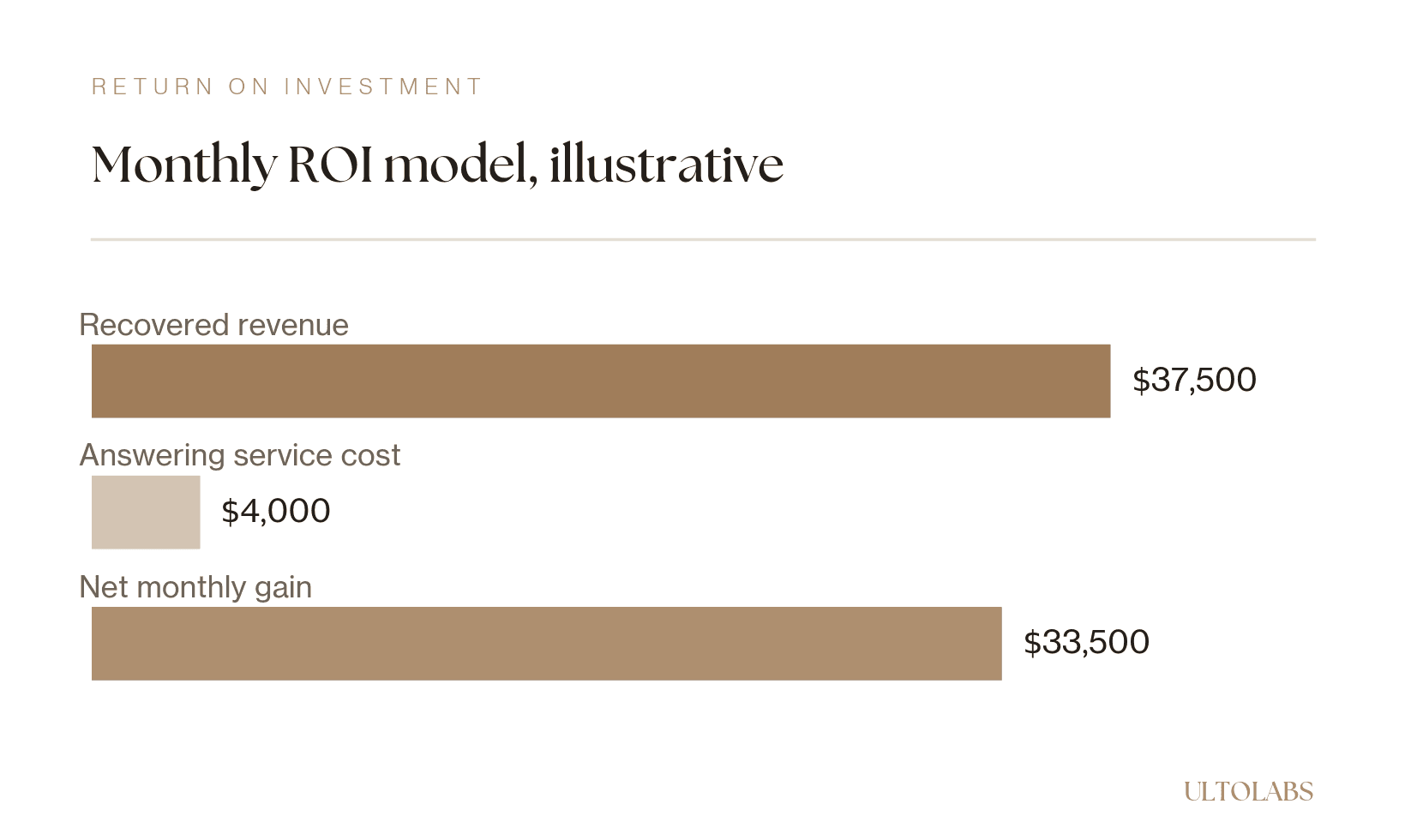
Illustrative model. Substitute your own call volume, conversion rate, and average deal value.
Why Is the Cost per Answered Call So Much Lower?
The cost per answered call drops sharply because a voice agent handles unlimited concurrent calls without shift premiums, benefits, or idle time. A human team is paid whether the phone rings or not, and paid extra to cover nights and weekends. An agent is paid for what it does.
Consider the coverage problem. A full week is 168 hours. Staffing all of them with reception means multiple shifts, holiday cover, and sick-day backup. The cost per answered call climbs because much of the paid time is spent waiting. During a rush, the same team cannot answer several calls at once, so calls still drop.
A voice agent inverts this. It answers the third and fourth simultaneous call as easily as the first. It covers the quiet 2am hour at no marginal staffing cost. The result is a lower and more predictable cost per answered call, which is exactly what a firm needs when call volume is growing faster than headcount.
Our finding: The firms with the strongest ROI are usually the ones with spiky, unpredictable call volume, because that is where human staffing is least efficient and an agent's flat coverage wins most.
How Fast Does the Investment Pay Back?
The payback is fast because recovered revenue starts on day one, while automation projects broadly show quick returns: Forrester's Total Economic Impact study documented a 248% three-year ROI for enterprises deploying automation platforms (Forrester TEI, 2024). For a front-desk agent, the first captured lead often covers the setup.
Unlike a marketing campaign that takes months to compound, an answering agent produces value on the first missed call it catches. There is no ramp. The moment it goes live on overflow and after-hours calls, it is booking business the firm would otherwise have lost.
That immediacy is why the payback window is usually measured in weeks, not quarters. A single recovered high-value client can offset months of cost. Everything after that is margin. For a growing firm watching cash carefully, few investments return this quickly with this little downside.
What Should a Growing Firm Measure After Launch?
A growing firm should measure four numbers after launch: answer rate, booking rate, cost per answered call, and recovered revenue. These turn a gut feeling into a defensible return, and they let you tune the agent for more. GCC firms scaling AI tend to win on exactly this discipline, since only 31% have fully deployed despite 84% adoption (McKinsey, 2025).
Track these from the first week:
Answer rate: the share of inbound calls the agent handles, targeting near-total coverage.
Booking rate: the share of answered calls that end in a booked or qualified outcome.
Cost per answered call: total agent cost divided by calls handled, watched over time.
Recovered revenue: bookings the agent produced that the team would have missed.
Review these monthly. When booking rate lags, refine the agent's script and knowledge. When certain call types convert best, expand the agent's role there. The numbers do not just prove ROI. They show you where to grow it.
Frequently Asked Questions
Is an AI answering service cheaper than a human receptionist?
For most growing firms, yes, especially once you count nights, weekends, and overflow. A voice agent has no shift premiums and answers unlimited calls at once, which lowers the cost per answered call, particularly when volume is spiky.
How quickly will I see a return?
Value begins on the first recovered call, so payback is usually measured in weeks. A single captured high-value lead often covers the setup cost, and broader automation studies show fast returns, including a 248% three-year ROI in Forrester's analysis.
What if my call volume is low?
Even low-volume firms lose real revenue to missed calls when each deal is valuable. The ROI depends on deal value as much as volume. A handful of recovered high-value bookings can justify the cost on its own.
Can I prove the ROI to my finance team?
Yes. Track answer rate, booking rate, cost per answered call, and recovered revenue from launch. Those four numbers give finance a clean, auditable view of return rather than a marketing claim.
Conclusion
An AI answering service is not a cost. It is a recovery system for revenue you are already losing. With missed calls costing a typical small firm an estimated $126,000 a year, and automation returns well documented, the ROI question is not whether it pays back but how fast.
UltoVoice runs on usage-based pricing plus a setup fee, so cost tracks value. Start with the calls you already miss, measure the four numbers that matter, and let the return build from there.
Sources: Forrester Total Economic Impact, 2024; McKinsey, The state of AI in GCC countries, retrieved 2026-07-10. Missed-call cost figures reflect widely cited 2025 research.