You win a client with a great pitch and lose them with a slow start. Onboarding is where the relationship is proven or broken, and most firms run it on memory, spreadsheets, and good intentions. Steps get missed, documents chased twice, and the client's first impression is disorganization. Automated client onboarding systems replace that chaos with logic, so every new client gets a fast, consistent, professional start.
This post covers why onboarding decides retention and how workflow logic accelerates it. It names UltoFlow's Onboarding Stack directly and builds on the cluster pillar on workflow automation services.
Key Takeaways
The early client experience shapes retention, and a slow, messy onboarding is a leading cause of early churn.
Automated onboarding removes missed steps, delays, and duplicated requests through workflow logic.
GCC organizations run AI agents in 86% of surveyed workflows (McKinsey, 2025).
Faster time-to-value means clients see results sooner and stay longer.
Why Does Onboarding Decide Whether Clients Stay?
Onboarding decides retention because a client's early experience sets their expectation for the whole relationship, and a slow, disorganized start signals what is to come. With 50% of work activities automatable (McKinsey, 2024), onboarding is one of the highest-value places to apply that logic, because the stakes are relationship-long.
The first weeks are fragile. A new client is watching closely, deciding whether they made the right choice. If documents are requested twice, steps are missed, or progress stalls, doubt sets in immediately. That doubt is expensive: a client who churns early takes their revenue and often their referrals with them, after you spent to acquire them.
The opposite is equally powerful. A client who experiences a fast, organized, professional onboarding relaxes into the relationship. They see momentum, feel in good hands, and reach their first result sooner. Onboarding is not admin. It is the moment retention is won or lost, and it deserves to be engineered rather than improvised.
Where Does Manual Onboarding Break Down?
Manual onboarding breaks down at the handoffs and the tracking, because it depends on people remembering every step for every client, and memory fails at scale. This is the same weakness that leaves 94% of organizations running error-prone repetitive tasks (McKinsey, 2024).
The failure points are consistent. A step is skipped because it lived in someone's head. A document is requested that the client already sent. A welcome sequence stalls because the person running it got busy. Progress is invisible, so no one notices a client is stuck until they complain or leave. Each of these is small, and together they define a poor first impression.
Scale makes it worse. Onboarding one client manually is manageable. Onboarding twenty at once, each at a different stage, overwhelms a manual process. Steps fall through, and the clients who slip are invisible until it is too late. Automation fixes this by making the process the system's job, not a person's memory.
Our finding: The most damaging onboarding failure is rarely a dramatic one. It is the quiet stall, where a client sits stuck at step three for two weeks because no one was tracking their progress.
How Does Workflow Logic Accelerate Onboarding?
Workflow logic accelerates onboarding by driving each step automatically, in the right order, and tracking progress so nothing stalls. It turns onboarding from a manual checklist into a self-running flow, which is why GCC firms run AI agents in 86% of surveyed workflows (McKinsey, 2025).
Here is what the logic does. On signing, it triggers the welcome sequence and the first document request automatically. It tracks what the client has completed and what is outstanding, sending reminders where needed. It moves the client to the next step the moment the current one is done, with no waiting for a person to notice and act.
The result is speed and consistency together. Every client gets the same professional sequence, and every client moves through it as fast as they are ready to. UltoFlow's Onboarding Stack is built for exactly this: a structured, automated onboarding flow that carries each new client from signed to set up without dropping a step.
Triggers welcome and document requests on signing.
Tracks completion and sends timely reminders.
Advances each client to the next step automatically.
Flags stalls so no client sits stuck unseen.
Delivers the same professional experience every time.
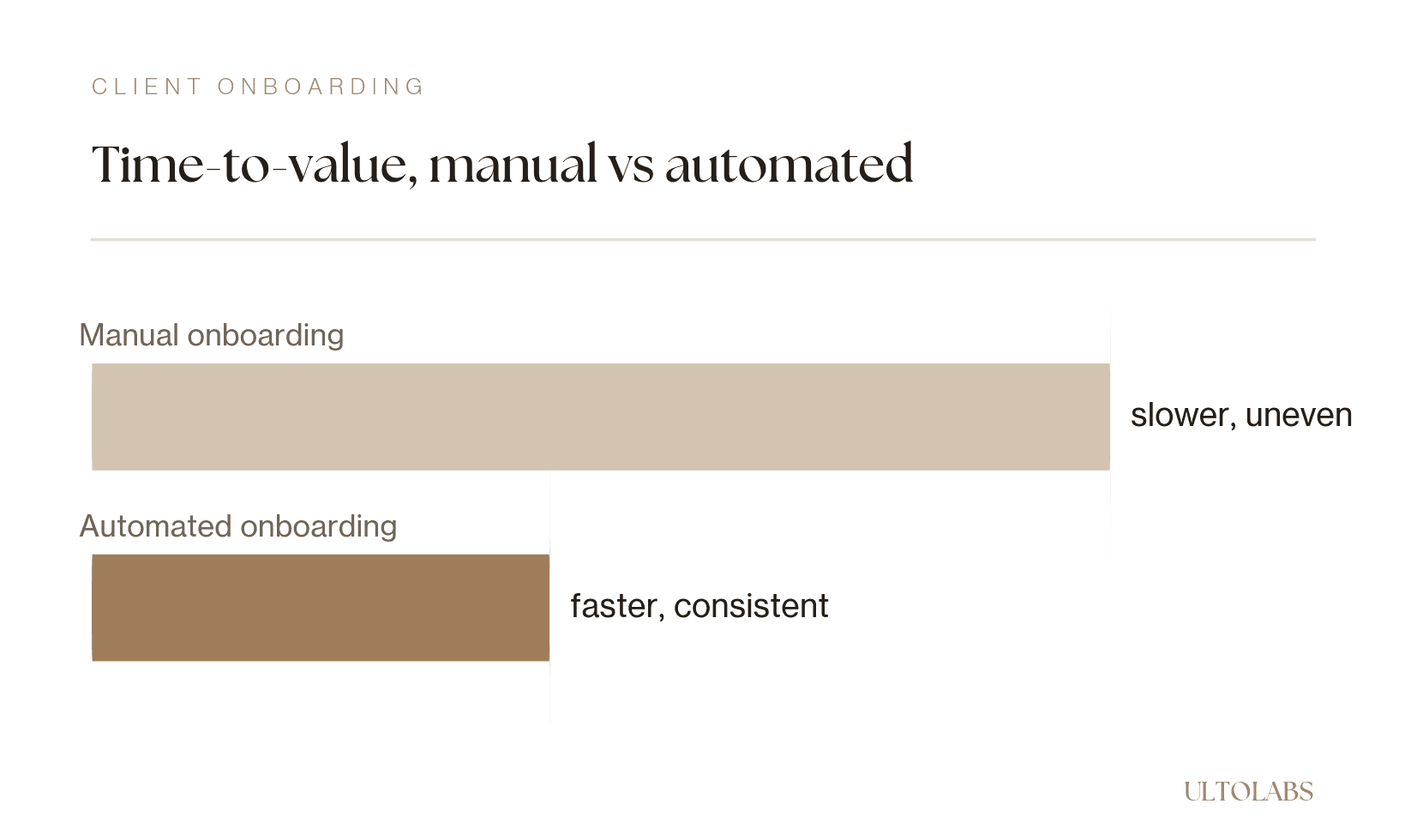
Automation shortens and standardizes time-to-value for new clients (illustrative).
How Does Faster Onboarding Improve Time-to-Value?
Faster onboarding improves time-to-value by getting clients to their first result sooner, which is the moment they truly commit. Every day shaved off setup is a day closer to the client seeing what they paid for, and that early win is what secures the relationship.
Time-to-value is the clock that matters. A client who reaches their first meaningful result quickly feels the decision was right and settles in. A client who waits weeks to see anything starts to doubt, regardless of how good the eventual result is. Automated onboarding compresses that wait by removing the delays that manual process introduces.
It also removes the friction that makes clients hesitate. When documents are requested once, steps flow in order, and progress is visible, the client feels momentum. That momentum carries them past the fragile early period into a stable relationship. Faster time-to-value is not just efficiency. It is retention, engineered into the first weeks.
How Do You Roll Out Onboarding Automation?
You roll out onboarding automation by mapping your current process, automating the highest-friction steps first, then extending to the full flow. This staged approach protects the client experience while it proves out, matching the disciplined rollouts that let GCC firms scale AI (McKinsey, 2025).
Start by mapping how onboarding actually works today, including the steps that live only in someone's head. Identify the highest-friction points: the document chase, the stalled handoff, the missed welcome step. Automate those first, since they cause the most damage and show the clearest improvement.
Then extend the logic to the full sequence, so every client flows from signed to set up automatically. Measure time-to-value, completion rate, and early retention. As the numbers improve, refine the timing and messaging. Within a few onboarding cycles, new clients get a fast, consistent start, and the early churn that manual onboarding caused fades.
Frequently Asked Questions
What is an automated client onboarding system?
It is a workflow that drives each onboarding step automatically, triggering welcome messages, requesting documents once, tracking completion, and advancing the client to the next step. It replaces manual checklists and memory with logic, so nothing is missed and every client gets a consistent start.
Will it feel impersonal to new clients?
No, when designed well it feels more organized and attentive, not less. Messages are written in your brand voice, and a human steps in for the moments that need judgment. Clients experience a smooth, professional start rather than a disorganized one.
How does it reduce early churn?
By getting clients to their first result faster and removing the friction that causes early doubt. A fast, consistent onboarding builds momentum and trust in the fragile first weeks, which is when many clients decide whether to stay.
Can it handle many clients onboarding at once?
Yes. This is where automation most outperforms manual process. It tracks every client's stage independently, sends the right reminders, and flags stalls, so onboarding twenty clients at once is as controlled as onboarding one.
Conclusion
Onboarding is where the relationship is proven, and manual process quietly breaks it with missed steps, delays, and stalls. Automated client onboarding systems replace that with workflow logic: fast, consistent, and professional for every client, from signing to setup. Faster time-to-value means clients see results sooner and stay longer.
UltoFlow's Onboarding Stack is built for this, carrying each new client through a structured, automated flow that never drops a step. Map your process, automate the friction, and turn onboarding into a retention engine.
Sources: McKinsey operations insights, 2024; McKinsey GCC AI, retrieved 2026-07-10.