You do not build a tower on a foundation poured for a shed. Yet most businesses try to run real intelligence on template websites built for static brochures, then wonder why the results are thin. Custom AI web development starts from the opposite premise: design the foundation for what the site must actually do, then build up. This is the architect's approach, and it is why custom sites convert where template sites stall.
This post covers how custom AI website development differs from template building, and why the architecture decides the results. It builds on the UltoWeb pillar on high-converting AI websites.
Key Takeaways
Real AI capability requires architecture built for it, which template platforms cannot fully provide.
Custom development integrates intelligence, personalization, and CRM connection at the foundation.
Personalization is linked to about 40% more revenue, and it depends on a site built to deliver it (McKinsey, 2025).
The architect's approach designs for the site's job first, then builds to match.
What Is the Architect's Approach to Web Development?
The architect's approach designs the website around what it must accomplish, then builds the structure to support it, rather than forcing goals onto a fixed template. It treats the site as a system with a job, and personalization alone is linked to around 40% more revenue when a site can actually deliver it (McKinsey, 2025).
An architect starts with purpose and constraints. What must this building do, who uses it, what load must it bear? Web development should work the same way. What must this site do: engage, qualify, capture, personalize, connect to the pipeline, be found by AI search? Those requirements shape the foundation, not the other way around.
A template inverts this. It gives you a fixed structure and asks you to fit your goals inside it. That works for a simple brochure and fails for a site that must run real intelligence, because the capabilities you need were never designed into the foundation. The architect's approach designs the foundation for the job, which is why it holds.
Why Can't Template Sites Hold Real Intelligence?
Template sites cannot hold real intelligence because their fixed structure was designed for static content, not integrated AI, personalization, and deep CRM connection. You can bolt a widget on, but the foundation was not poured for it, so it stays shallow. This is the same ceiling that off-the-shelf tools hit in automation.
The limits show up quickly. A template can host a generic chatbot but rarely one deeply connected to your CRM and your logic. It can display content but rarely personalize it per visitor in real time. It can collect a form but rarely qualify and route leads into your pipeline automatically. Each capability you actually need pushes against a structure that was not built to hold it.
The result is a site that looks modern and behaves like a brochure. The intelligence is superficial because the architecture is superficial. To get real capability, the intelligence has to be designed into the foundation, connected to your systems, and built to the site's actual job. That is the difference between decoration and development.
Our finding: The most common cause of a disappointing AI website is not a weak chatbot. It is a strong chatbot bolted onto a template that cannot connect it to anything, so it answers questions but never becomes part of the pipeline.
How Does Custom Development Integrate Intelligence?
Custom development integrates intelligence by building engagement, personalization, and CRM connection into the site's foundation, so they work as one system rather than disconnected parts. This integration is what turns capability into results, and it is why GCC firms increasingly run AI agents across their workflows and sites (McKinsey, 2025).
Integration means the pieces talk to each other. The conversational engagement is connected to the CRM, so a captured lead is routed and worked. The personalization draws on real visitor signals, so it adapts meaningfully. The AI-ready structure supports discovery, so the site is found. Each capability reinforces the others because they were designed together.
A custom build also fits your specific business: your services, your pricing logic, your languages, your pipeline. It is shaped around how you actually operate rather than a generic template's assumptions. UltoWeb builds this way, with chatbot tiers for text and voice, a standalone SEO, GEO, and AEO offering, and site builds from landing page to elite, all designed as one integrated system.
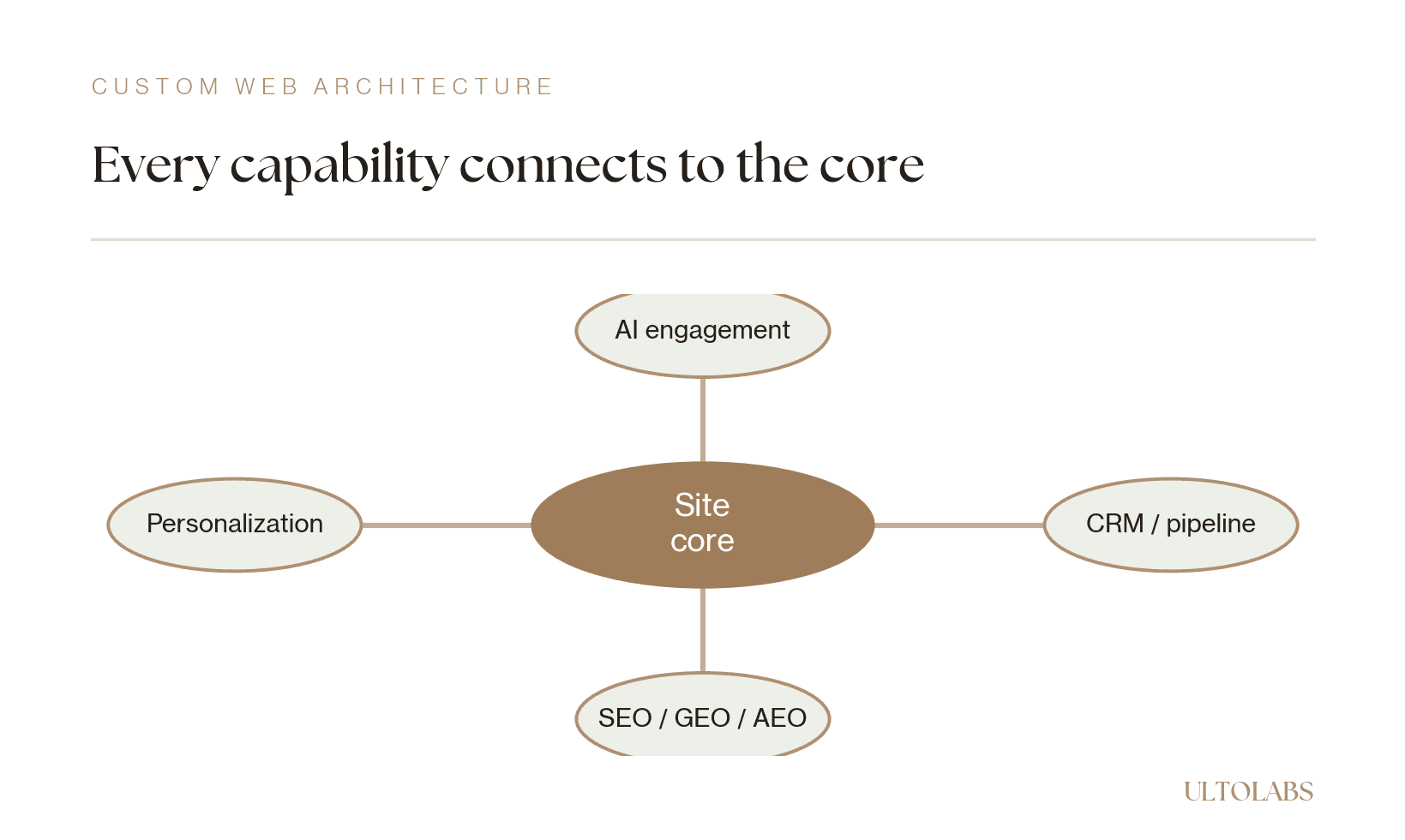
In a custom build, every capability connects to the site core rather than sitting apart.
Why Does Architecture Decide the Results?
Architecture decides the results because a site's ceiling is set by its foundation, and no amount of features overcomes a structure that cannot connect them. This is why two sites with the same chatbot can perform completely differently: one is integrated, the other is decorated.
Consider two firms. Both add AI to their site. The first bolts a chatbot onto a template, disconnected from the CRM and unable to personalize. The second builds intelligence into a custom foundation, connected to the pipeline and adapting to each visitor. Same feature on paper, entirely different results, because the architecture determines whether the feature actually works.
For a Middle East firm competing for high-value clients, that difference is decisive. The architecture is not a technical detail buried under the design. It is the thing that determines whether the site converts or just looks like it should. Building for the job first is what makes the intelligence pay off.
Unique insight: Features are visible and architecture is not, which is why firms overspend on the former and underspend on the latter. The visible chatbot gets the attention, but the invisible foundation decides whether it ever earns its keep.
How Should a Middle East Firm Commission a Custom AI Site?
A Middle East firm should commission a custom AI site by defining the site's job first, then requiring integration, bilingual engagement, and AI discoverability in the build. This ensures the architecture matches the goals rather than the goals bending to a template. GCC adoption is high but scaling is disciplined, with only 31% fully deployed despite 84% adoption (McKinsey, 2025).
Begin by stating what the site must do: the actions visitors should take, the friction to remove, the pipeline it must feed. Require that intelligence be integrated, not bolted on, and connected to your CRM. Require bilingual Arabic and English engagement as core. Require AI discoverability through SEO, GEO, and AEO, so the site is found in an AI-first market.
Then build to those requirements, tier by tier, from landing page to elite build depending on scope. Measure conversion, capture, and lead quality against the site's stated job. Commissioned this way, the site is a system engineered for results, not a template dressed up to look intelligent. That is the architect's approach, and it is how custom pays off.
Frequently Asked Questions
What is custom AI website development?
It is building a website around its actual job, with intelligence, personalization, and CRM connection integrated into the foundation. Unlike a template with a bolted-on widget, a custom build designs the architecture to support real AI capability, so features connect and actually drive results.
Isn't a template site cheaper?
A template has a lower upfront price but a lower ceiling. For a simple brochure it is fine. For a site that must engage, personalize, capture, and connect to your pipeline, a template cannot hold the capability, so it costs more in lost conversion than it saves in build.
Can custom development handle Arabic and English?
Yes, and bilingual engagement should be core to the build, not an add-on. A custom site engages, personalizes, and captures in both languages, matching how Middle East visitors communicate and widening the share of traffic it converts.
How does the architecture affect SEO and AI search?
A custom build can be structured so AI answer engines and search crawlers understand and cite it, which a rigid template often cannot. UltoWeb pairs the build with a standalone SEO, GEO, and AEO offering so the site is discoverable in an AI-first market.
Conclusion
Real intelligence needs a foundation built to hold it. Template sites, designed for static content, cannot, so the AI bolted onto them stays shallow and the results stay thin. Custom AI web development takes the architect's approach: define the site's job, then build the foundation to support engagement, personalization, and pipeline connection as one system. Architecture decides the results.
UltoWeb builds custom sites this way, from landing page to elite build, with integrated chatbot tiers and a standalone SEO, GEO, and AEO offering. Design for the job first, and the intelligence pays off.
Sources: McKinsey Personalization Report, 2025; McKinsey GCC AI, retrieved 2026-07-10.