Your brand is only as strong as the last call a customer made to you. A rushed greeting at 8pm, a call that rings out on a Friday, a receptionist who forgot the pricing: each one chips away at the reputation you spent years building. An AI voice assistant for business holds the line at a fixed, professional standard, no matter the hour or the volume.
This post is about consistency. Not just answering the phone, but answering it the same polished way every single time, across every hour your market is awake.
Key Takeaways
About 85% of callers who reach voicemail never call back, so an off-hours gap is a permanent loss (BIA/Kelsey).
An AI voice assistant delivers the same greeting, accuracy, and tone on call one and call one thousand.
GCC organizations already run AI agents in 86% of surveyed workflows (McKinsey, 2025).
Professionalism scales when it stops depending on who happens to be at the desk.
Why Does Call Consistency Decide Your Reputation?
Call consistency decides reputation because callers generalize from a single experience, and most never give a second chance: roughly 85% who hit voicemail do not call back (BIA/Kelsey). One dropped call becomes a permanent verdict on your reliability. A voice assistant removes the variance that makes reputation fragile.
Human reception is inconsistent by nature. The best receptionist has an off day. A new hire needs weeks to learn your pricing. A busy afternoon turns careful answers into rushed ones. None of this reflects a lack of effort. It reflects the reality that people are variable and demand is not.
A voice assistant flattens that curve. The greeting is scripted to your brand. The answers come from your verified knowledge base. The qualifying questions are asked in full, every time. Callers experience the same competent front desk whether they dial at 9am on Monday or 11pm on a holiday. That reliability is what a premium brand sounds like.
What Does "24/7 Professionalism" Actually Require?
True 24/7 professionalism requires three things at once: constant availability, consistent quality, and instant accuracy, and no human-only team delivers all three affordably. In the GCC, 84% of organizations have adopted AI in some form (McKinsey, 2025), precisely because manual coverage cannot stretch that far.
Availability means no hour goes dark. Nights, weekends, Eid, and peak-hour overflow all get answered. Quality means every answer is on-brand and correct, not a tired approximation. Accuracy means the information is current, so a caller asking about hours or service bands gets the real answer, not a guess.
Trying to buy all three with headcount is expensive and fragile. Night shifts cost a premium and still leave gaps. A voice assistant delivers all three from a single trained system. It never tires, never improvises your pricing, and never leaves the phone unattended.
Our finding: When firms audit their off-hours calls, the volume is almost always higher than they assumed, and the intent is often more urgent than daytime calls.
How Does a Voice Assistant Keep Every Call On-Brand?
A voice assistant keeps calls on-brand by working from a controlled script and knowledge base rather than improvisation, so tone and facts stay fixed. This is the opposite of a call center, where quality depends on the individual. In 2026, GCC firms report 86% use of AI agents in daily workflows (McKinsey, 2025), and voice is a leading use case for this reason.
Three controls make it work:
A brand voice profile defines greeting, tone, pacing, and sign-off, so the agent sounds like you.
A verified knowledge base supplies the facts, so answers stay accurate as your business changes.
Guardrails define what the agent handles and when it routes to a human, so it never oversteps.
The result is a front desk you can actually govern. If your pricing changes, you update one source and every future call reflects it. If you refine your greeting, the change applies instantly across all hours. Consistency stops being a training problem and becomes a settings problem.
Can an AI Assistant Handle Arabic and English Callers?
Yes, and across the Middle East that bilingual ability is not optional. A single business line serves callers who open in Arabic and continue in English, and a professional front desk follows them. A voice assistant switches languages within a call without breaking stride.
This matters more than most firms plan for. A caller who has to repeat themselves or restart in another language feels friction, and friction reads as unprofessional. An agent that greets in Arabic, answers a question in English, and confirms a booking back in Arabic feels effortless to the caller and impossible to fault.
Bilingual coverage also widens your market. You stop turning away callers because the person at the desk speaks only one language. Every caller gets a competent conversation, which is exactly what a regional brand needs to project.
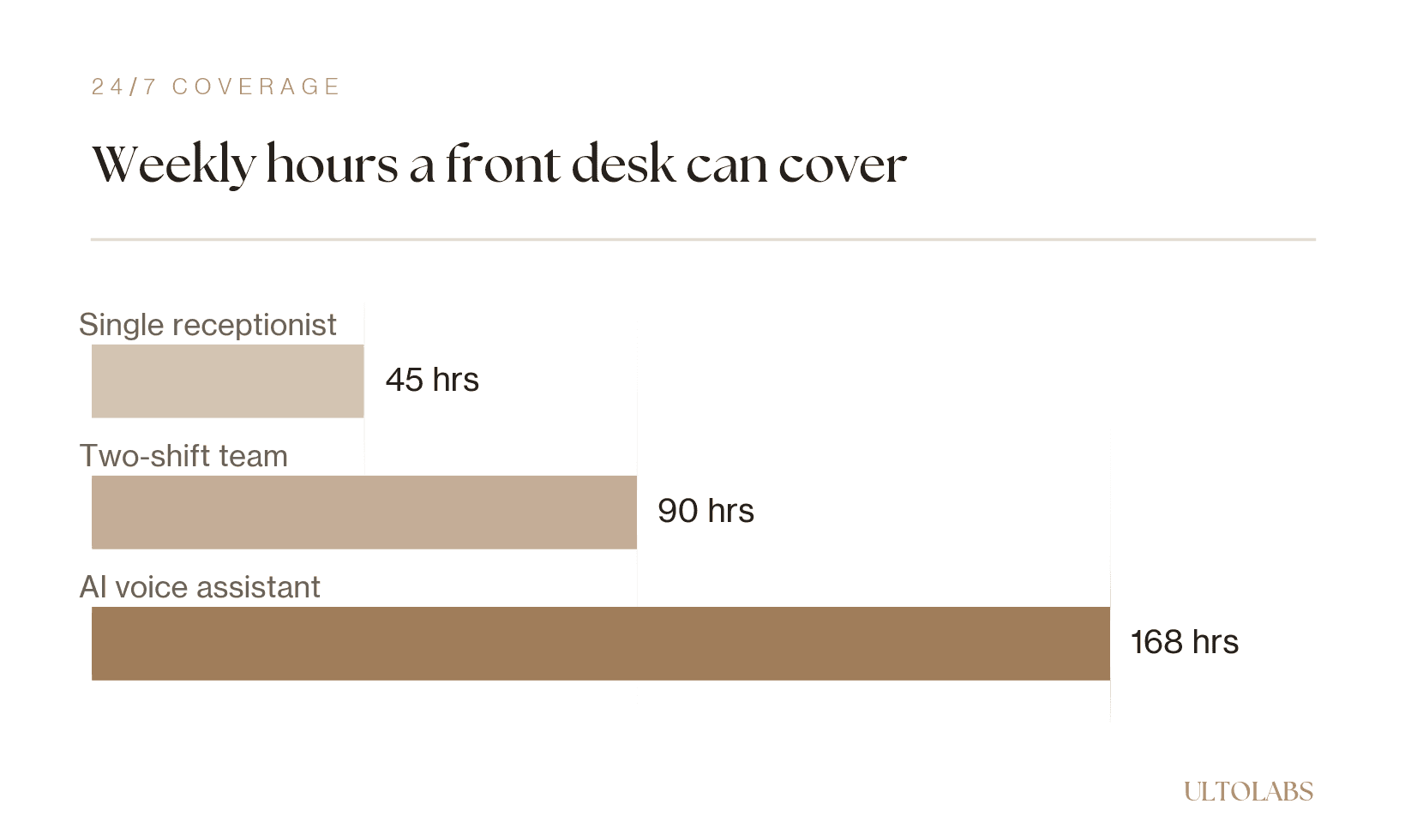
Illustrative weekly coverage. A full week is 168 hours.
Where Does the Human Team Fit In?
The human team fits exactly where judgment, empathy, and complex negotiation live, while the assistant absorbs the repeatable volume. This split is what makes professionalism scalable, and it is how leading GCC firms deploy AI: not to remove people, but to point them at higher-value work.
In practice, the agent handles the first contact for most calls. It greets, answers the standard questions, qualifies, and books. When a call needs a specialist, a sensitive conversation, or a decision outside the rules, the agent routes it with full context attached. The specialist picks up already knowing who is calling and why.
That handoff is the quiet win. Your team stops being a switchboard and starts each conversation warm. Customers feel the difference, because they never repeat themselves and never wait. The brand feels bigger and more organized than the headcount would suggest.
Unique insight: A voice assistant does not make your team smaller. It makes your team's time more expensive, in the good sense, because every minute now goes to work only a human can do.
Frequently Asked Questions
Does an AI voice assistant sound robotic?
Modern voice agents hold natural, flowing conversations with realistic pacing and tone. Recent industry testing puts caller satisfaction with well-built agents on par with human reception. The goal is a competent, on-brand conversation, not a novelty.
What happens when a caller asks something the agent does not know?
The agent routes the call to a human with context, or takes a message and triggers a follow-up, depending on your rules. It is designed to hand off gracefully rather than guess, which protects accuracy and brand trust.
How does it stay accurate as my business changes?
Answers come from a knowledge base you control. Update pricing, hours, or services in one place and every future call reflects the change instantly. There is no retraining lag and no stale scripts.
Can it cover only after-hours calls?
Yes. Many firms start with after-hours and overflow, where the agent catches calls the team would otherwise miss, then expand its scope once it proves accuracy. It is a low-risk way to begin.
Conclusion
Professionalism used to depend on who was at the desk. With an AI voice assistant for business, it depends on a standard you set once and apply everywhere. Every caller gets the same polished greeting, the same accurate answers, and the same competent booking, in Arabic or English, at any hour.
UltoVoice delivers that standard around the clock, freeing your team for the conversations that need a human. Set the bar once, then let every call meet it.
Sources: McKinsey, The state of AI in GCC countries, retrieved 2026-07-10. Voicemail figures reflect widely cited BIA/Kelsey research.