Most deals are lost in the gaps between touches. A rep follows up once, gets no reply, and moves on, while the prospect who needed a second nudge goes quiet and then goes elsewhere. Automated customer follow up systems remove those gaps. They contact every lead at the right moment, as many times as it takes, without a rep having to remember or care.
This post covers the science: why timing and persistence decide conversion, and how to build a follow-up system that never lets a lead go cold. It builds on the cluster pillar on workflow automation services.
Key Takeaways
Chili Piper's 2025 study of 4 million form submissions found instant response booked 66.7% of meetings versus 30% for standard follow-up (Chili Piper, 2025).
Responding within one minute delivered 391% better conversion in Velocify research (speed-to-lead research, 2025).
Most leads need multiple touches, yet most reps stop after one.
Automated follow-up delivers perfect timing and persistence that manual effort cannot match.
Why Does Follow-Up Timing Decide the Sale?
Follow-up timing decides the sale because buyer intent decays fast, and the firm that reaches them first while intent is high usually wins. Chili Piper's 2025 analysis of 4 million form submissions found instant response booked 66.7% of meetings versus 30% for standard follow-up (Chili Piper, 2025). Speed more than doubled the result.
Intent is perishable. A prospect who fills a form is interested now, not next week. Every hour of delay lets that interest cool and lets competitors reach them first. Velocify research found responding within one minute delivered 391% better conversion than waiting (speed-to-lead research, 2025). The window is measured in minutes, not days.
Manual follow-up cannot hold that window. A rep is in a meeting, on another call, or off shift when the lead arrives. By the time they respond, the moment has passed. Automation responds instantly, every time, which is the only way to consistently catch intent at its peak.
Why Does Persistence Beat a Single Touch?
Persistence beats a single touch because most leads do not convert on the first contact, yet most reps stop there, leaving deals on the table. The gap between the number of touches needed and the number reps actually make is where automated systems win.
Buyers are busy and distracted. A first message that goes unanswered is usually not a no. It is a not-right-now. The lead needed a second or third touch, at a different time or on a different channel, and a manual process rarely delivers it consistently. Reps deprioritize non-responders and chase fresh leads instead, so the follow-up that would have converted never happens.
Automated systems are relentless in a good way. They deliver the full sequence: multiple touches, spaced correctly, across the right channels, until the lead responds or the sequence completes. No lead is abandoned after one try because a rep got busy. That persistence, applied evenly to every lead, recovers deals that manual effort quietly loses.
Persistence also removes the bias in who gets chased. A rep, working from memory and mood, naturally follows up hardest with the leads that feel promising and neglects the rest. That instinct is often wrong, because the quiet lead is sometimes the serious buyer who simply had a busy week. An automated system does not play favorites. It works every lead with the same discipline, so the deals hiding in the neglected majority are the ones you recover. Over a quarter, that even treatment is where the pipeline growth comes from.
Our finding: In most pipelines we review, the single biggest recoverable loss is not slow first response. It is the second and third touch that never happened because a rep moved on.
What Does an Automated Follow-Up System Include?
An automated follow-up system includes instant first response, a multi-touch sequence, multi-channel delivery, and intelligent handoff to a human at the right moment. Together these encode the science of timing and persistence into a system that runs itself, which is why GCC firms run AI agents in 86% of surveyed workflows (McKinsey, 2025).
A complete system covers:
Instant first touch the moment a lead arrives, on the channel they used.
A multi-touch sequence, spaced by proven timing, that continues until the lead engages.
Multi-channel delivery across WhatsApp, email, and SMS, in Arabic or English.
Intelligent stop-and-handoff: when the lead replies with intent, a rep takes over with context.
Full logging in the CRM, so nothing is duplicated or dropped.
The handoff is what keeps it human. Automation handles the timing and persistence that machines do better, then steps back the instant a real conversation begins. The rep enters warm, informed, and at exactly the right moment. That division is the whole design.
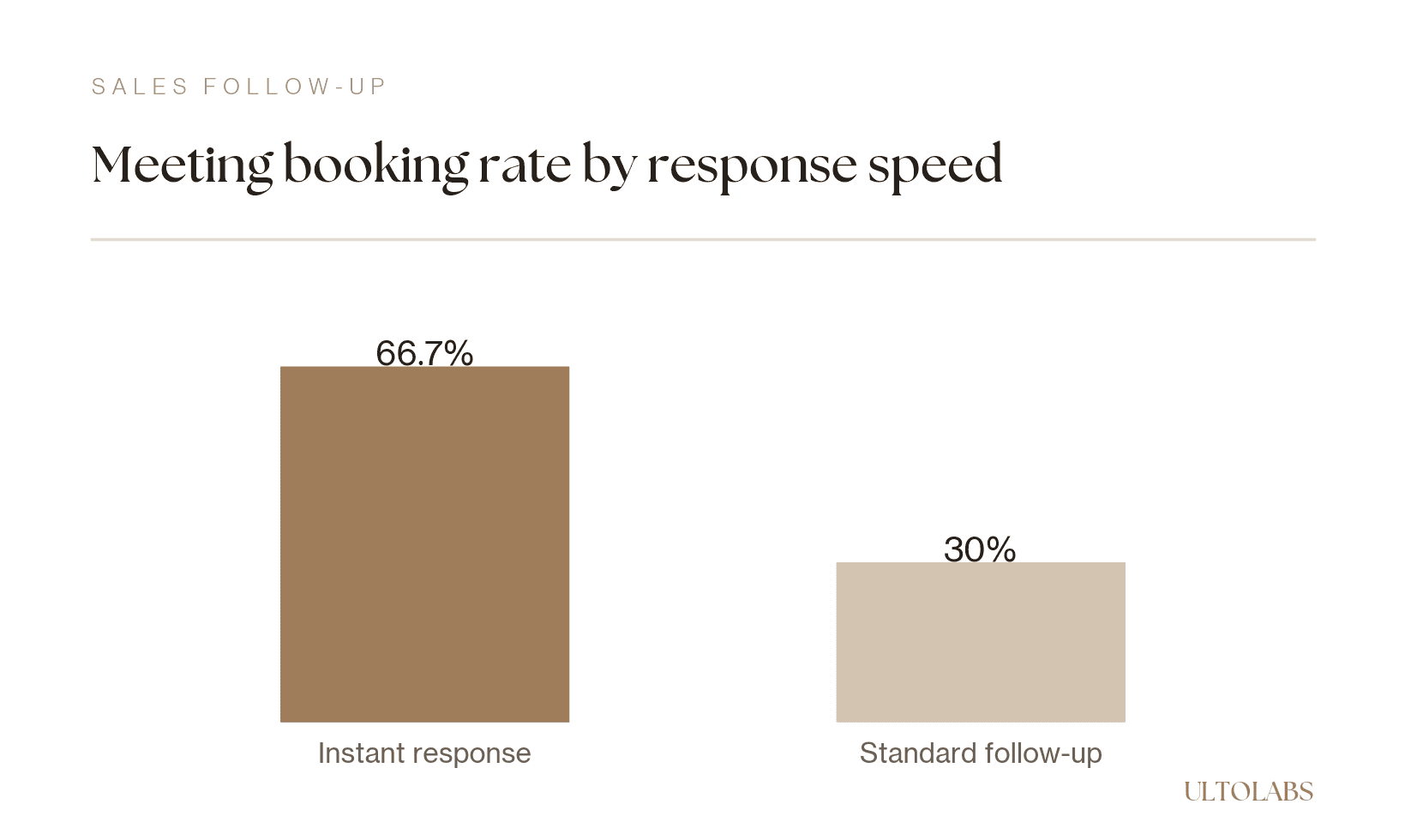
Instant response more than doubled meeting bookings (Chili Piper, 2025).
How Do You Keep Automated Follow-Up From Feeling Robotic?
You keep automated follow-up human by writing sequences in your brand voice, personalizing with real data, and handing off to a rep the moment a genuine conversation starts. Automation handles cadence, not warmth, and the two should not be confused.
The risk with follow-up automation is generic, obviously templated messages that annoy prospects. The fix is design. Each touch is written to sound like your firm, references the specific reason the lead came in, and adds value rather than just nagging. In Arabic or English, the tone matches how you would actually speak to a prospect.
The second safeguard is the handoff. Automation is for the mechanical part, the timing and persistence. The instant a lead replies with real intent, the sequence stops and a rep takes over. The prospect never feels stuck talking to a machine during a real conversation. Done this way, automation feels like attentive follow-up, not a robot chasing them.
Unique insight: Prospects do not resent being followed up with. They resent being followed up with badly. Good automation is more personal than a rushed rep, not less, because it never forgets the details or the timing.
Frequently Asked Questions
How many follow-up touches should a sequence have?
Most leads need several touches, and the right number depends on your deal type and sales cycle. The key is that the sequence continues past the first message, which is where most manual follow-up fails, until the lead engages or the sequence completes.
Will automated follow-up annoy my prospects?
Not if it is designed well. Messages written in your brand voice, personalized to why the lead came in, and stopped the moment a real conversation starts feel attentive, not robotic. The annoyance comes from generic templates, which good automation avoids.
Can it follow up on WhatsApp?
Yes. Automated sequences run across WhatsApp, email, and SMS in Arabic or English, meeting Middle East prospects on the channel they prefer. WhatsApp follow-up in particular tends to see strong engagement in the region.
When does a human take over?
The moment a lead replies with genuine intent. Automation handles the timing and persistence, then hands off to a rep with full context so the real conversation is warm and informed. The machine never stays in a live human conversation.
Conclusion
Sales are won in the gaps: the instant first response and the second and third touch that manual effort forgets. With instant response more than doubling meeting bookings and one-minute replies delivering far higher conversion, the science is settled. Automated follow-up delivers the timing and persistence no rep can sustain across every lead.
UltoFlow builds follow-up systems that respond instantly, persist intelligently, and hand off to your team at the right moment, in your brand voice and your languages. Close the gaps where your deals are quietly leaking.
Sources: Chili Piper, 2025; Speed-to-lead statistics, 2025; McKinsey GCC AI, retrieved 2026-07-10.