A CRM is only as good as the discipline feeding it, and human discipline slips. Leads get logged late, routed slowly, and worked inconsistently, so the expensive ones slip through. Bespoke CRM automation fixes the discipline problem at the source. It captures every lead, routes it in seconds, enriches the record, and triggers the right follow-up, without depending on anyone remembering to.
This post is about protecting high-value leads specifically, where the cost of a dropped record is highest. It builds on the cluster pillar on workflow automation services.
Key Takeaways
78% of customers buy from the first company that responds (speed-to-lead research, 2025).
Over 30% of leads are never contacted at all, usually through manual gaps (speed-to-lead research, 2025).
Bespoke CRM automation captures, routes, enriches, and follows up without human delay.
High-value leads justify custom logic, because one lost record can outweigh the entire build cost.
Why Do CRMs Fail to Protect High-Value Leads?
CRMs fail to protect high-value leads because they depend on people to feed them promptly and consistently, and people do not, so over 30% of leads are never contacted at all (speed-to-lead research, 2025). The tool is fine. The manual process around it leaks.
The failure is mundane. A lead comes in while the rep is busy, so logging waits. By the time it is entered, the routing is delayed, and the follow-up is late or forgotten. Each manual step is a chance to drop the record, and high-value leads are dropped at the same rate as low-value ones, because the process does not know the difference.
That is the real cost. Losing a small lead stings. Losing a large one because nobody logged it fast enough is a direct hit to revenue. Automation removes the human bottleneck: the lead is captured, routed, and actioned the instant it arrives, before anyone has a chance to forget.
How Does Speed of Response Change Conversion?
Speed of response changes conversion dramatically, because buyers reward the first firm to reach them: 78% purchase from whoever responds first (speed-to-lead research, 2025). Manual processes cannot deliver that speed reliably, which is why automation matters so much here.
The data is blunt. Responding within five minutes can raise conversion by a large multiple compared to a delay of even half an hour, yet only a small minority of firms respond that fast. The reason is structural: a human cannot watch every channel every minute. Automation can. It sees the lead the second it lands and responds immediately.
Bespoke CRM automation closes the speed gap by acting on arrival. It logs the lead, routes it to the right rep, and can send an instant first touch, all within seconds. The firm that responds first wins the majority of deals, and automation is the only way to be first consistently rather than occasionally.
Our finding: The firms that win on speed are almost never the ones with the fastest reps. They are the ones whose first response does not depend on a rep being free at that moment.
What Does Bespoke CRM Automation Actually Do?
Bespoke CRM automation captures, routes, enriches, and triggers follow-up for every lead, tailored to your rules and your definition of high value. It handles the interpretive and structured steps together, which is why 86% of GCC organizations already run AI agents in workflows (McKinsey, 2025).
A well-built system covers the full lead lifecycle at capture:
Captures leads from every channel: forms, WhatsApp, calls, and ads, into one CRM.
Enriches the record with available data, so reps start informed.
Scores and prioritizes by your high-value criteria, not a generic default.
Routes instantly to the right rep or team based on your rules.
Triggers the correct first touch and follow-up sequence automatically.
The word "bespoke" is the point. A generic CRM automation applies generic rules. A bespoke system encodes your definition of a high-value lead, your routing logic, and your follow-up cadence. That specificity is what protects the leads that matter most to your revenue.
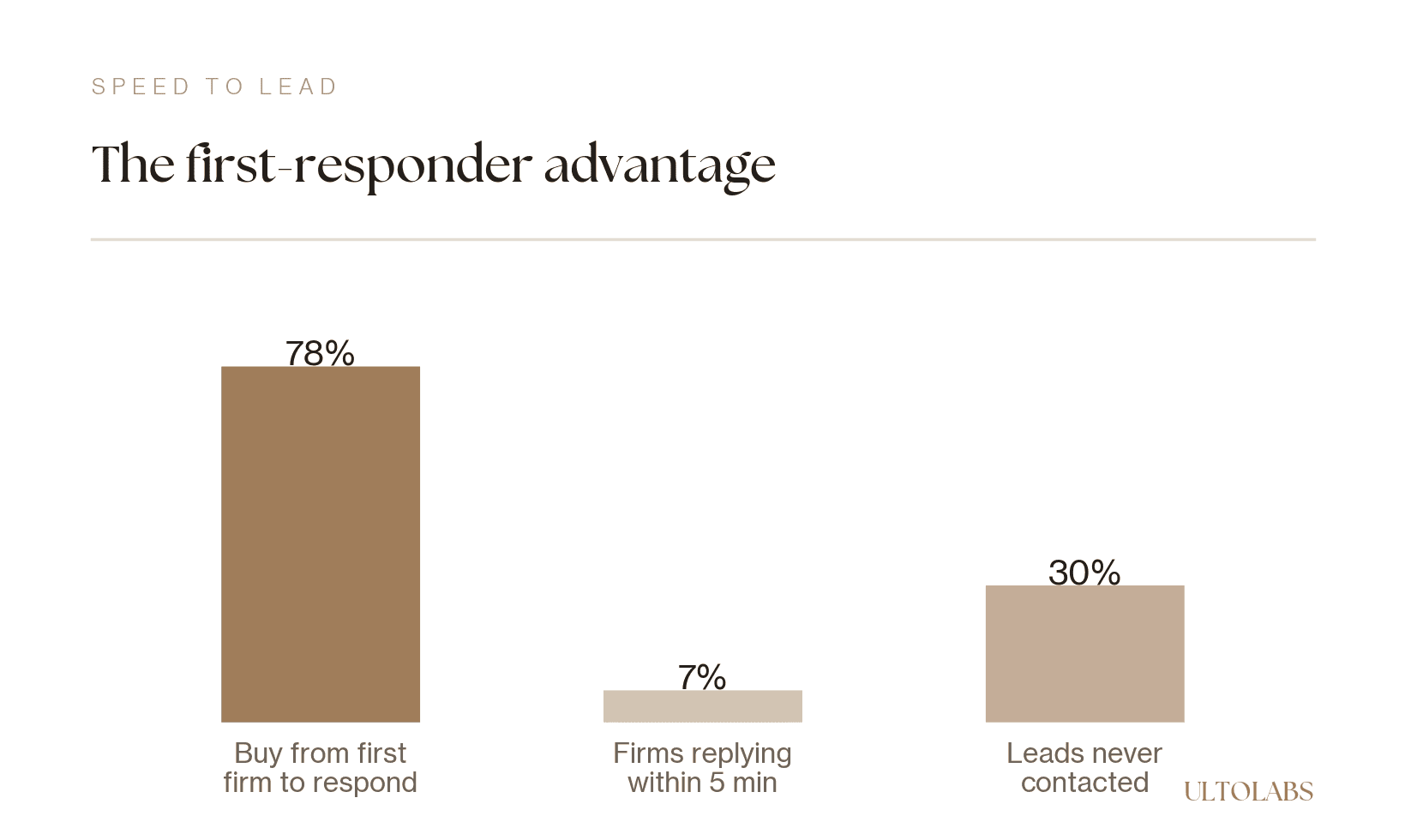
The gap between what wins and what firms actually do (speed-to-lead research, 2025).
How Does It Handle Multi-Channel Leads in the Middle East?
It handles multi-channel leads by unifying every source, including WhatsApp, into one CRM with consistent routing, which matters because Middle East buyers reach out across many channels. A lead that arrives on WhatsApp should be treated with the same speed and rigor as one from a web form.
WhatsApp is central in the region, and it is exactly where manual processes fail: messages sit unread, get answered late, or never make it into the CRM at all. Bespoke automation reads the inbound message, understands intent, creates or updates the CRM record, and routes it, in Arabic or English, without a person in the loop.
Unifying channels also gives you a complete view. Instead of leads scattered across a phone, an inbox, and a chat app, everything lands in one system with full context. Reps stop hunting for where a lead came from and start working it. UltoFlow's WhatsApp Automation and CRM logic combine to make this one continuous flow.
How Do You Deploy CRM Automation Safely?
You deploy CRM automation safely by starting with capture and routing, proving accuracy, then layering on scoring and follow-up. This staged approach protects your pipeline data while it proves out, and it mirrors how GCC firms move from adoption to real scale (McKinsey, 2025).
Begin with the highest-impact, lowest-risk step: automatic capture and routing. Every lead gets logged instantly and sent to the right place. Run it alongside your current process briefly to confirm nothing is missed, then rely on it. This alone recovers the leads that manual gaps were dropping.
Next, add enrichment and scoring so reps start informed and priorities are clear. Finally, layer in automated first touch and follow-up sequences. Measure at each stage: response time, contact rate, and conversion on high-value leads. The pipeline gets tighter and faster one layer at a time, with your data protected throughout.
Frequently Asked Questions
Will CRM automation work with my existing CRM?
Yes. Bespoke automation is built to connect to the CRM you already use, orchestrating capture, routing, enrichment, and follow-up around it. The aim is to make your current system reliable and fast, not to force a migration to a new platform.
How does it define a high-value lead?
It uses your criteria, not a generic default. Scoring rules are built around what high value means for your business, whether that is deal size, industry, source, or behavior, so the leads that matter most get priority routing and follow-up.
Can it capture leads from WhatsApp?
Yes. It reads inbound WhatsApp messages in Arabic or English, understands intent, and creates or updates the CRM record automatically. This closes the most common leak in Middle East pipelines, where WhatsApp leads never reach the CRM.
How fast can it respond to a new lead?
It acts within seconds of a lead arriving, logging, routing, and triggering a first touch. Since 78% of buyers choose the first firm to respond, that instant response is often the difference between winning and losing the deal.
Conclusion
A CRM does not lose leads. The manual process around it does. With over 30% of leads never contacted and 78% of buyers rewarding the first responder, the cost of manual gaps is highest exactly where it hurts most: high-value leads. Bespoke CRM automation removes those gaps by capturing, routing, enriching, and following up the instant a lead arrives.
UltoFlow builds this around your rules and your channels, including WhatsApp, so the leads that drive your revenue are never the ones that slip. Start with capture and routing, then layer on scoring and follow-up.
Sources: Speed-to-lead statistics, 2025; McKinsey GCC AI, retrieved 2026-07-10.