Growth exposes broken processes. The manual steps that worked at ten clients collapse at a hundred. Staff spend their days copying data between systems, chasing approvals, and re-entering the same information, while the real work waits. Workflow automation removes that drag. It connects your systems so work moves on its own, and your team spends its time on what matters.
This is the blueprint. It covers what workflow automation services in the UAE actually deliver, where the returns come from, and how to sequence a rollout that pays back fast. Every other post in this cluster links back here.
Key Takeaways
McKinsey estimates 60% of employees could save 30% of their time through workflow automation (McKinsey, 2024).
Forrester documented a 248% three-year ROI for enterprises deploying automation platforms (Forrester TEI, 2024).
GCC organizations are moving fast: 86% already run AI agents in daily workflows (McKinsey, 2025).
The return comes from recovered time, fewer errors, and faster cycle times, not from cutting headcount.
What Is Strategic Workflow Automation?
Strategic workflow automation is the practice of connecting your systems and rules so routine work runs without manual effort, sequenced by business value rather than by whatever is easiest to build. McKinsey estimates 50% of current work activities are automatable with existing technology (McKinsey, 2024), which means the question is not whether to automate but what to automate first.
The word "strategic" matters. Random automation of convenient tasks produces a patchwork that breaks and confuses. Strategic automation starts from the processes that cost the most in time, errors, or delay, then rebuilds them as reliable flows. A lead arrives and is routed, qualified, and logged automatically. A quote is generated and sent without a person assembling it by hand. An approval moves the moment conditions are met.
This is not about buying a tool and hoping. It is about mapping the work, finding the expensive manual steps, and replacing them with logic that runs the same way every time. In the GCC, 86% of organizations already run AI agents in daily workflows (McKinsey, 2025), which means the competitive baseline has already shifted.
UltoFlow delivers this as custom automation across four sub-tiers: WhatsApp Automation, a Quotation Agent, an Onboarding Stack, and a Full Flow bundle that ties them together.
Where Does the Return on Automation Come From?
The return comes from three sources: recovered staff time, fewer errors, and faster cycle times, and the time figure alone is large. McKinsey estimates 60% of employees could save 30% of their time through automation (McKinsey, 2024). That recovered time is capacity you do not have to hire for.
Recovered time is the headline. Every hour a person spends copying data or chasing a status is an hour not spent selling, serving, or building. Automation gives that time back. Fewer errors is the quiet second lever: manual steps produce typos, missed handoffs, and dropped tasks, each of which costs money to fix or a customer to lose.
Faster cycle times is the third and often the most valuable. When a quote goes out in minutes instead of days, or a lead is contacted instantly instead of tomorrow, conversion rises. Forrester's Total Economic Impact analysis put the three-year ROI of automation platforms at 248% (Forrester TEI, 2024). The return is real and it compounds.
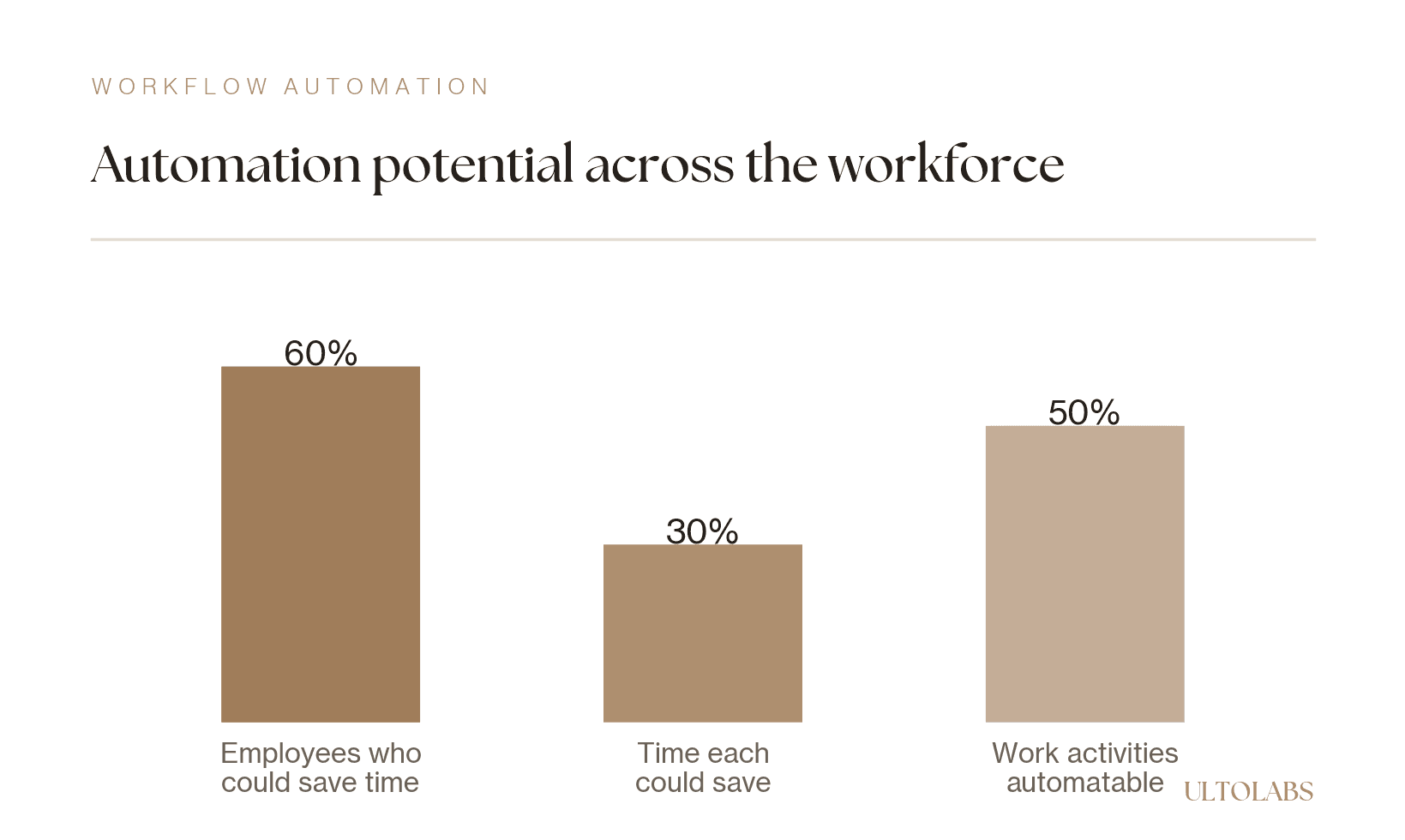
Automation potential across the workforce (McKinsey, 2024).
Which Processes Should You Automate First?
You should automate first the processes that combine high volume, high manual effort, and high error cost, because that is where the return lands fastest. With 50% of work activities automatable (McKinsey, 2024), the constraint is prioritization, not possibility.
Look for these signatures. Repetitive data entry between systems. Manual routing of leads or tickets. Quote and proposal assembly done by hand. Onboarding checklists tracked in someone's head or a spreadsheet. Follow-up sequences that depend on a person remembering. Each of these is high-volume, error-prone, and directly tied to revenue or cost.
Rank candidates by value, not by ease. The most convenient thing to automate is rarely the most valuable. Start where a broken process is quietly costing you the most, then expand. This is the difference between automation that transforms operations and automation that just adds another disconnected tool.
Custom Automation vs. Off-the-Shelf Tools
Custom automation wins when your processes are specific, connected, and central to revenue, because generic tools force your business to bend to their limits. Off-the-shelf platforms are fast to start and quick to hit a ceiling, especially as complexity grows.
The trade-off is real. A stock tool handles simple, common flows well and cheaply. But as your process involves your pricing rules, your CRM fields, and your approval logic, generic tools require workarounds that pile up into fragility. A custom build is shaped around your actual process, so it scales instead of breaking.
For a growing Middle East firm, the deciding question is how central the process is. Automate a peripheral task with a stock tool. Automate the flow that drives your revenue with a custom system that will hold under load and change. That distinction is where most automation budgets are won or wasted.
Unique insight: The cheapest automation is not the one with the lowest sticker price. It is the one that does not break when your business grows, because rebuilding a failed automation costs more than doing it right once.
How Do You Roll Out Automation Without Disruption?
You roll out automation without disruption by automating one high-value process end to end, proving it, then moving to the next, rather than trying to transform everything at once. This sequencing is why some GCC firms scale while others stall at pilots, with only 31% fully deployed despite 84% adoption (McKinsey, 2025).
Pick one process that hurts, map it fully, and rebuild it as a reliable flow. Run it alongside the manual version briefly to confirm it holds, then switch over. Measure the time saved, the errors avoided, and the cycle-time gain. That single win builds the confidence and the budget for the next.
Then repeat. Each automated process feeds the next, and the connected flows start to compound. Within a few cycles, the manual drag that slowed growth is gone, and the team is working on higher-value tasks. The blueprint is not a big-bang transformation. It is a disciplined sequence of wins.
Frequently Asked Questions
How much time can workflow automation actually save?
McKinsey estimates 60% of employees could save around 30% of their time through automation. Real results depend on how manual your current processes are, but firms with heavy data entry, routing, and follow-up work typically see the largest gains.
Will automation replace my staff?
The goal is to remove repetitive work, not people. Automation recovers staff time so your team focuses on selling, serving, and building. Most firms redeploy that recovered capacity into growth rather than cutting roles.
How quickly does automation pay back?
Returns start as soon as the first process goes live. Forrester's analysis documented a 248% three-year ROI for automation platforms, and firms often recover setup costs within the first automated flow through saved time and higher conversion.
Do I need to replace my current software?
Usually not. Custom automation connects the tools you already use, orchestrating them into flows rather than replacing them. The aim is to make your existing stack work together, not to force a costly migration.
Conclusion
Manual process is a tax on growth, and it grows heavier as you scale. Strategic workflow automation removes it by connecting your systems so routine work runs on its own. With McKinsey putting potential time savings near 30% per employee and Forrester documenting strong ROI, the case is not close.
UltoFlow delivers this as custom automation, from WhatsApp and quotation flows to a full onboarding stack. Start with the process that costs you most, prove the return, and build from there.
Sources: McKinsey operations insights, 2024; Forrester Total Economic Impact, 2024; McKinsey GCC AI, retrieved 2026-07-10.