Off-the-shelf connectors are brilliant for small, clean tasks and painful for large, messy ones. Every enterprise that outgrows them hits the same wall: rising per-task costs, brittle chains that break on edge cases, and logic too complex for a template. If you are searching for Zapier alternatives for enterprise, you have probably already hit that wall. This post compares the two honestly and shows where custom AI pays off.
It builds on the cluster pillar on workflow automation services and gives you a decision framework, not a sales pitch.
Key Takeaways
Off-the-shelf tools excel at simple, structured tasks and struggle with complex, judgment-heavy enterprise workflows.
Custom AI automation handles interpretive steps and deep integration that templates cannot.
McKinsey estimates 50% of work activities are automatable, but the hard ones need more than rules (McKinsey, 2024).
The deciding factors are complexity, cost at scale, and how central the process is to revenue.
When Do Off-the-Shelf Tools Actually Work Well?
Off-the-shelf tools work well for simple, structured, low-volume connections where a fixed rule reliably does the job. They are the right tool for a large share of tasks, and McKinsey's estimate that 50% of activities are automatable includes many such clean steps (McKinsey, 2024). Dismissing them entirely would be wrong.
For moving a form submission into a spreadsheet, posting a notification, or syncing two apps on a clear trigger, a template connector is fast, cheap, and perfectly adequate. There is no reason to build custom for these. The mistake is not using off-the-shelf tools. The mistake is using them for workflows they were never designed to carry.
The trouble starts when the task stops being simple. Multiple conditions, unstructured input, deep integration with your CRM logic, or high volume all push these tools past their comfort zone. That is the boundary where the comparison actually matters, and where enterprises start searching for alternatives.
Where Do Off-the-Shelf Tools Break at Enterprise Scale?
Off-the-shelf tools break at enterprise scale in three places: complexity, cost, and fragility. As workflows involve judgment and volume rises, templates strain, and the 94% of organizations with repetitive judgment tasks feel this most (McKinsey, 2024). The wall is predictable.
Complexity is the first crack. Real enterprise processes have branches, exceptions, and interpretive steps that a linear template cannot express cleanly. Teams end up chaining dozens of steps and bolting on workarounds, which is where the second problem appears: fragility. A long chain of connected steps breaks when any one link changes, and debugging it is a job in itself.
Cost is the third. Per-task pricing that is trivial at low volume becomes a real line item at enterprise scale, and it grows exactly as you succeed. You end up paying more for a system that is harder to maintain and less capable than a purpose-built one. That is the point where custom automation becomes the cheaper option, not the more expensive one.
Our finding: Enterprises rarely abandon off-the-shelf tools because of a single failure. They abandon them because the maintenance burden of brittle chains quietly grows until it exceeds the cost of building it right.
How Does Custom AI Automation Solve These Problems?
Custom AI automation solves the enterprise problem by handling judgment steps, integrating deeply, and holding up under load, because it is built around your process instead of a template. This is what lets it automate the interpretive workflows that templates cannot, in line with the 86% of GCC firms already running AI agents in workflows (McKinsey, 2025).
On complexity, custom AI reads unstructured input and makes decisions, so branches and exceptions are handled by reasoning rather than an ever-growing rule tree. On integration, it connects directly to your CRM logic, your pricing rules, and your systems, rather than passing data through a shallow connector. On fragility, a purpose-built flow is engineered to hold, with clear escalation instead of silent breakage.
On cost, custom automation is a build investment rather than a per-task meter, so it does not punish you for growing. As volume rises, the economics improve, which is the opposite of the off-the-shelf curve. For a revenue-central workflow, that difference compounds into a decisive advantage.
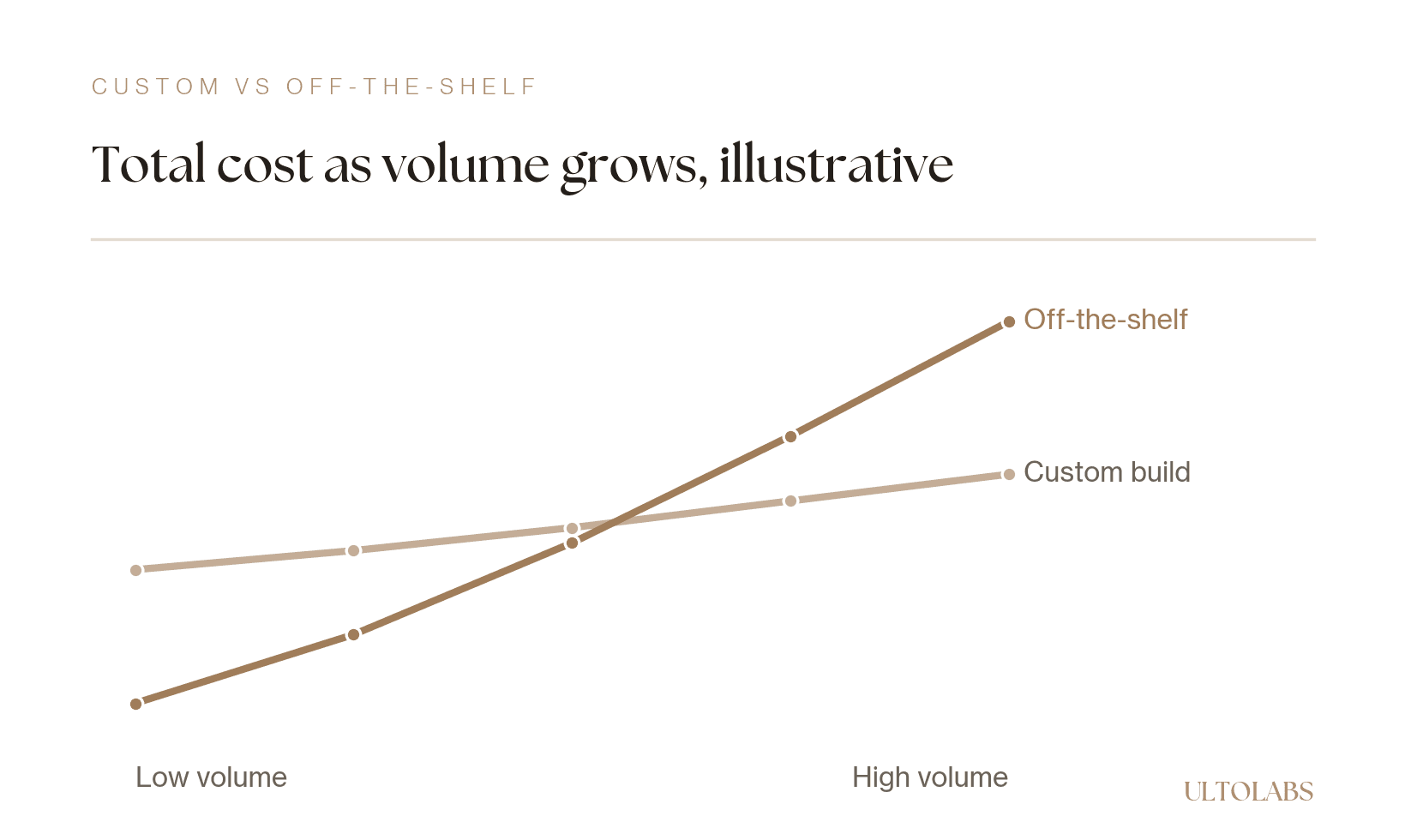
Illustrative cost curves. Off-the-shelf costs rise with volume; custom holds flatter.
Which Should You Choose for a Given Workflow?
You should choose based on three questions: how complex the workflow is, how much volume it carries, and how central it is to revenue. Simple, low-volume, peripheral tasks favor off-the-shelf. Complex, high-volume, revenue-critical ones favor custom. This framework prevents both overbuilding and outgrowing your tools.
Use this test. If the workflow is a clean trigger-and-action on structured data, and it is not central to your revenue, an off-the-shelf connector is the right call. Do not build custom for it. If the workflow involves judgment, connects deeply to your core systems, runs at high volume, or directly drives revenue, custom is the durable choice.
Many enterprises run both, deliberately. Off-the-shelf for the long tail of simple integrations, custom for the handful of processes that define the business. The skill is drawing that line on purpose rather than discovering it when a stock tool collapses under a workflow it was never built to hold.
Simple, structured, peripheral: off-the-shelf.
Complex, interpretive, revenue-critical: custom.
High and growing volume: custom, on cost grounds alone.
Deep CRM or pricing logic: custom, on capability grounds.
What Does Migrating From Off-the-Shelf to Custom Look Like?
Migrating from off-the-shelf to custom looks like replacing your most brittle, expensive workflow first, then retiring stock chains as custom flows prove out. This staged migration avoids disruption while capturing the biggest wins early, matching the disciplined rollouts that let GCC firms scale rather than stall (McKinsey, 2025).
Start with the workflow causing the most pain: the fragile chain that breaks weekly, or the high-volume process whose per-task cost has become uncomfortable. Rebuild it as a custom flow, run both in parallel to confirm accuracy, then cut over. That single migration usually pays for itself quickly through recovered reliability and lower running cost.
From there, migrate by priority, not all at once. Keep off-the-shelf tools for the simple tasks where they still win. The end state is not "custom everything." It is the right tool for each workflow, with your critical processes on a system built to hold.
Frequently Asked Questions
Is custom AI automation always better than tools like Zapier?
No. For simple, structured, low-volume tasks, off-the-shelf tools are faster and cheaper, and custom would be overkill. Custom wins specifically for complex, high-volume, revenue-critical workflows where templates break or become expensive.
Won't custom automation cost more?
It is a build investment rather than a per-task meter. For low volume it can cost more, but as volume grows the economics flip, because off-the-shelf per-task pricing rises while a custom system's running cost stays flatter. For core workflows, custom is often cheaper over time.
Can custom automation handle Arabic and English input?
Yes. Custom AI interprets meaning across languages, including mixed and informal text, so it handles bilingual workflows that rigid connectors cannot. This is important for Middle East enterprises serving customers in both languages.
Do I have to replace all my current automations?
No. The smart path is to migrate your most brittle or expensive workflow first, keep off-the-shelf tools for simple tasks, and move others by priority. The goal is the right tool per workflow, not wholesale replacement.
Conclusion
Off-the-shelf tools are excellent servants and poor masters. They handle simple integrations beautifully and buckle under the complex, high-volume, revenue-critical workflows that define an enterprise. If you are hunting for Zapier alternatives for enterprise, the real answer is usually custom AI for the processes that matter and off-the-shelf for the ones that do not.
UltoFlow builds custom automation for the workflows your business runs on, with the judgment handling and deep integration templates lack. Start by replacing your most brittle chain, prove the gain, and migrate by priority.
Sources: McKinsey operations insights, 2024; McKinsey GCC AI, retrieved 2026-07-10.