Anyone can demo an AI workflow. Making one that holds under real load, real edge cases, and real business stakes is a different discipline entirely. That discipline is engineering, and it is the reason most AI pilots impress in a meeting and disappoint in production. This piece looks under the hood at what AI workflow engineering actually involves, and why it decides whether an AI project delivers impact or becomes a costly demo.
It is a technical authority piece bridging the UltoFlow and UltoGold offerings. It builds on the workflow automation pillar and speaks to leaders evaluating who should build their systems.
Key Takeaways
Most AI pilots stall in production: GCC firms show 84% adoption but only 31% full deployment (McKinsey, 2025).
The gap between a demo and a durable system is engineering: integration, error handling, and reliability.
Engineered workflows handle edge cases, scale, and failure gracefully, where demos break.
Impact comes from systems built to hold, not prototypes that impress once.
Why Do Most AI Pilots Fail in Production?
Most AI pilots fail in production because a demo only has to work once under ideal conditions, while a production system has to work always under messy ones. The evidence is the deployment gap: 84% of GCC organizations have adopted AI, but only 31% have scaled it (McKinsey, 2025). That 53-point gap is where engineering was missing.
A demo is a controlled performance. It uses clean input, avoids edge cases, and runs once for an audience. Production is the opposite: unpredictable input, constant edge cases, high volume, and real consequences when something breaks. A workflow that dazzles in a demo often collapses the first time it meets a malformed message, a system outage, or ten times the expected load.
The difference is not the AI model. It is everything around it: how the workflow integrates, handles errors, and holds under load. That surrounding structure is engineering, and its absence is why so many pilots impress and then quietly die. Bridging the demo-to-production gap is the whole job.
What Does AI Workflow Engineering Actually Involve?
AI workflow engineering involves integration, error handling, reliability, and scale, the disciplines that turn a working idea into a system that holds. These are what separate the 31% who deploy from the majority stuck in pilots (McKinsey, 2025).
The core disciplines are:
Integration: connecting the workflow deeply to your real systems, so it acts rather than just suggests.
Error handling: anticipating malformed input, failures, and edge cases, and handling them gracefully.
Reliability: ensuring the workflow runs consistently, with monitoring and clear escalation.
Scale: building so performance holds as volume grows, not just at demo size.
Each of these is invisible in a demo and decisive in production. A prototype skips them because it only has to work once. An engineered system builds them in because it has to work every time. This is why the same idea can be a throwaway demo or a durable business system depending entirely on the engineering around it.
Why Does Error Handling Decide Real Impact?
Error handling decides real impact because production is defined by the unexpected, and a workflow that breaks on the first surprise delivers nothing. In business, 94% of organizations run repetitive tasks full of variation (McKinsey, 2024), and variation is exactly what naive workflows cannot handle.
Consider what real input looks like. Messages with typos, missing fields, unexpected formats, and requests no one anticipated. A demo never sees these. Production sees them constantly. A workflow without error handling treats each surprise as a crash, so it fails often and loses trust fast. A workflow engineered for errors expects the unexpected and handles it: it recovers, escalates, or routes to a human with context.
That graceful failure is what makes a system trustworthy enough to rely on. Users forgive a system that handles problems cleanly and abandon one that breaks unpredictably. Error handling is not a technical nicety. It is the difference between a workflow people depend on and one they route around, which is the difference between impact and waste.
Unique insight: The quality of an AI system is revealed not when everything goes right but when something goes wrong. A demo shows you the happy path. Engineering is entirely about the unhappy ones.
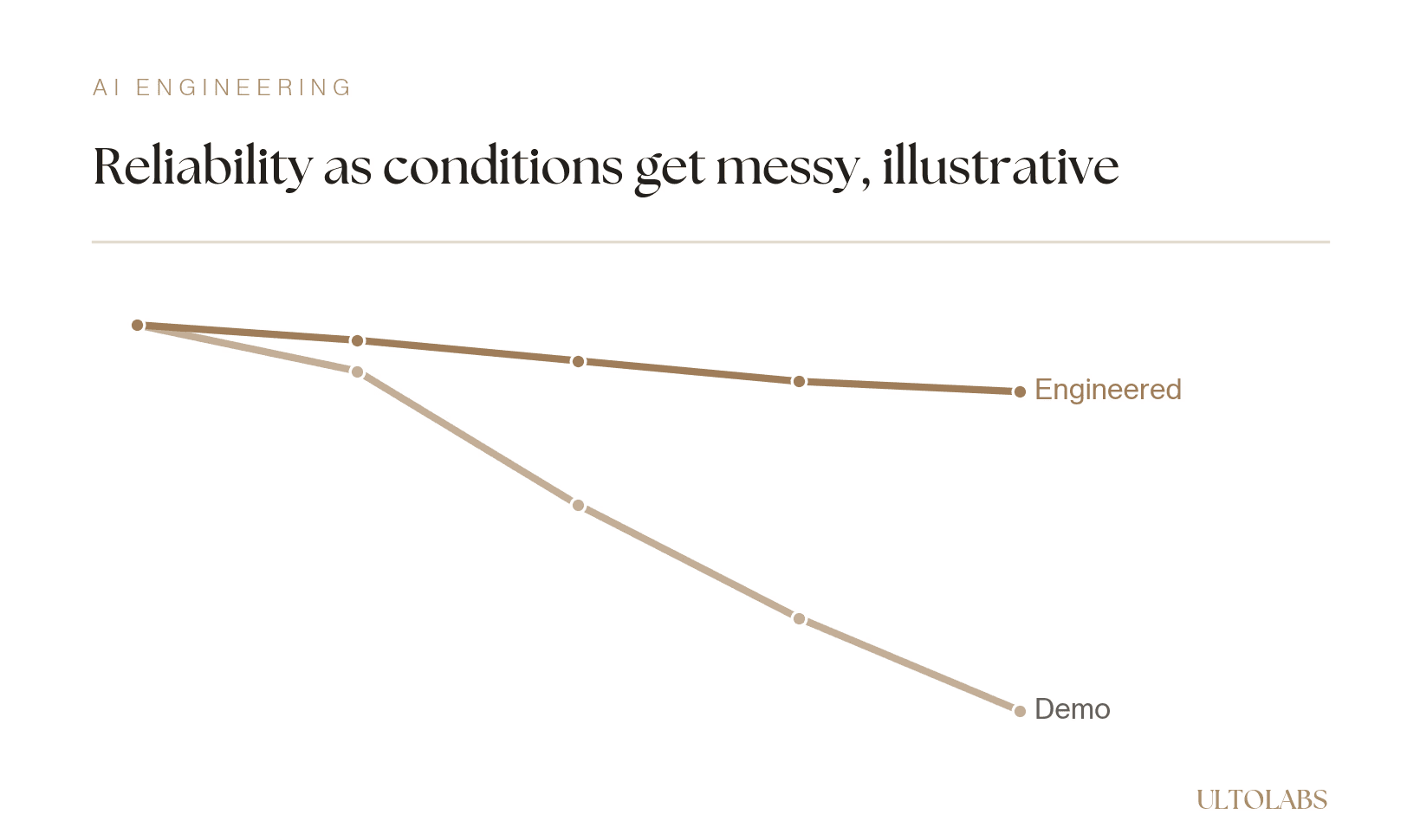
Engineered systems hold as conditions get messy; demos degrade.
How Does Engineering Enable Scale?
Engineering enables scale by building workflows whose performance holds as volume rises, rather than degrading the moment they leave demo conditions. This matters because business value comes at volume, and 50% of work activities are automatable in principle (McKinsey, 2024), but only if the systems hold.
A prototype is usually built for one case at a time. Push real volume through it and it slows, drops tasks, or falls over, because it was never designed for load. An engineered workflow is built for scale from the start: it handles concurrent work, maintains performance as volume grows, and is monitored so problems surface before they spread.
Scale is where impact actually lives. Automating one task is a demo. Automating thousands reliably is a business transformation. The engineering that lets a workflow handle that volume without breaking is what converts a promising idea into real operational advantage. This is the level UltoGold operates at: full-stack implementation engineered to hold at scale.
How Should a Leader Evaluate an AI Build Partner?
A leader should evaluate an AI build partner on their engineering discipline, not their demo, because the demo is easy and the production system is hard. Ask how they handle errors, integration, reliability, and scale, since those answers predict whether a project joins the 31% that deploy or the majority that stall (McKinsey, 2025).
The right questions expose the engineering. How does the system handle malformed input or a downstream outage? How does it integrate with our existing stack rather than sit beside it? How is it monitored, and what happens when something fails? How does performance hold as our volume grows? A partner who answers these concretely is building systems. One who only shows a slick demo is selling a prototype.
For a Middle East firm making a real investment, this distinction is everything. The impressive demo is the cheap part. The engineering that makes it survive production is where the value and the difficulty both sit. UltoFlow and UltoGold are built on that engineering discipline, so what impresses in a meeting also holds in production.
Frequently Asked Questions
What is AI workflow engineering?
It is the discipline of building AI workflows that hold in production, covering integration, error handling, reliability, and scale. It is the difference between a demo that works once and a system that works every time, under real input, real load, and real failures.
Why do so many AI projects stall after the pilot?
Because a pilot only has to work once under ideal conditions, while production demands constant reliability under messy ones. The gap is engineering, which explains why GCC firms show 84% adoption but only 31% full deployment. The missing piece is the structure around the model.
Is the AI model the hard part?
Usually not. The model is often the easy part. The hard part is everything around it: connecting it to real systems, handling the unexpected, keeping it reliable, and making it scale. That surrounding engineering is what decides whether the project delivers impact.
How do I know if a build will hold in production?
Ask about error handling, integration, monitoring, and scale, not just for a demo. A partner who answers those concretely is engineering a system. Concrete answers about the unhappy paths, not a polished happy-path demo, are the signal that a build will survive real conditions.
Conclusion
The distance between an AI demo and a system that delivers is engineering. Integration, error handling, reliability, and scale are invisible in a meeting and decisive in production, which is why 84% of GCC firms adopt AI but only 31% truly deploy it. Impact comes from systems built to hold, not prototypes that impress once and break under real conditions.
UltoFlow and UltoGold are built on that engineering discipline, so the workflows that win the demo also survive production. When you evaluate an AI build, judge the engineering, because that is what you are actually buying.
Sources: McKinsey GCC AI, 2025; McKinsey operations insights, retrieved 2026-07-10.