Rule-based automation moves data. Intelligent automation makes decisions. The difference matters when your workflows involve judgment: reading a message, classifying a request, deciding where a lead should go. Older automation stops at the first ambiguity. Intelligent AI works through it, which is why it can streamline the messy, real workflows that simple tools cannot touch.
This post explains what "intelligent" adds to workflow automation, and where it produces the biggest gains for Middle East enterprises. It builds on the cluster pillar on workflow automation services.
Key Takeaways
McKinsey found 94% of organizations perform repetitive tasks that automation could eliminate (McKinsey, 2024).
Intelligent AI handles judgment steps, not just data movement, so it automates workflows rule-based tools cannot.
GCC organizations run AI agents in 86% of surveyed workflows (McKinsey, 2025).
The gain is in fewer human handoffs and faster, more accurate decisions at scale.
What Makes an AI Workflow "Intelligent"?
An AI workflow is intelligent when it can interpret unstructured input and make a decision, rather than only following a fixed if-this-then-that rule. This is what lets it handle the 94% of organizations' repetitive tasks that involve some judgment (McKinsey, 2024). The step from rules to reasoning is the whole point.
A rule-based flow needs perfectly structured input. A form field maps to a database column. The moment input is messy, a free-text message, an email, a varied request, the rule breaks and a human takes over. Intelligent AI reads that messy input, understands intent, and routes or acts accordingly. It classifies, extracts, and decides.
That capability changes what can be automated. Instead of only the clean, structured steps, you can automate the interpretive ones: reading an inbound WhatsApp message and routing it, extracting details from an unstructured request, deciding which team a query belongs to. In 2026, GCC enterprises run AI agents across 86% of surveyed workflows (McKinsey, 2025), precisely because intelligence unlocks these steps.
Where Do Human Handoffs Slow Enterprises Down?
Human handoffs slow enterprises wherever a person has to read, decide, and pass work along, because each handoff adds delay, error, and inconsistency. With 94% of organizations running such repetitive judgment tasks (McKinsey, 2024), the cumulative drag is enormous.
Every handoff is a pause. A message sits in an inbox until someone reads it. A lead waits until someone decides which rep gets it. A request stalls until someone classifies it. These pauses are invisible individually and crippling in aggregate, especially at enterprise volume where thousands of small delays stack up.
Handoffs also introduce variance. Two people classify the same request differently. One forgets a step the other remembers. Intelligent AI removes the pause and the variance at once: it reads, decides, and acts instantly, the same way every time. The work flows instead of queuing.
Our finding: In most enterprise process audits, the biggest time loss is not the work itself. It is the waiting between steps, where a task sits idle until a human picks it up. Intelligent automation deletes that idle time.
How Does Intelligent AI Handle Messy, Real-World Input?
Intelligent AI handles messy input by understanding meaning rather than matching a fixed pattern, so it copes with the variety of real customer communication. This is the capability that lets it automate WhatsApp messages, emails, and free-text requests that would break a rule-based system.
Consider inbound messages. Customers write in their own words, in Arabic or English, with typos and shorthand. A rule cannot anticipate every phrasing. Intelligent AI reads the message, identifies what the customer wants, and takes the right action: answer, route, book, or escalate. The variety that defeats rules is exactly what it is built to absorb.
This extends across the enterprise. Extracting order details from a supplier email. Classifying a support request by urgency. Pulling the relevant fields from an unstructured form. Each of these is a judgment step, and each becomes automatable when the system can interpret rather than only match. UltoFlow's WhatsApp Automation tier is one direct application of this.
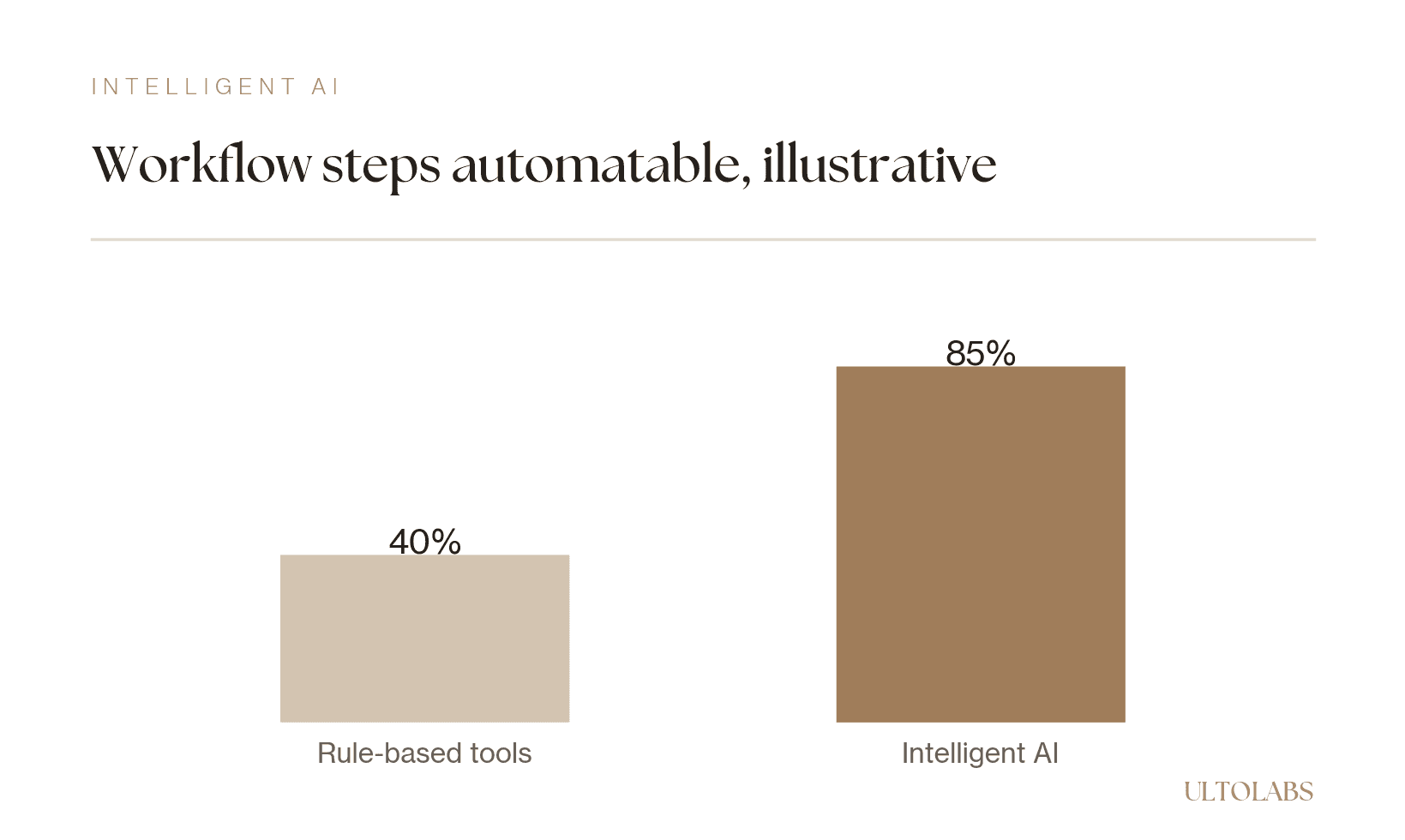
Intelligent AI extends automation beyond structured steps to judgment steps
What Does an Intelligent Workflow Look Like in Practice?
An intelligent workflow looks like a chain where each step, including the judgment ones, runs without a person, ending in a completed outcome. This is how enterprises collapse multi-day processes into minutes. GCC firms already run AI agents in 86% of surveyed workflows (McKinsey, 2025), and the pattern is consistent.
Take an inbound lead. A message arrives on WhatsApp. Intelligent AI reads it, identifies the intent, extracts the contact and need, checks the CRM, and either books a call or routes to the right rep with full context. What used to be a person reading, deciding, copying, and following up becomes a single automatic flow that finishes in seconds.
The human enters only at the point of real value: the sales conversation, the complex decision, the relationship. Everything upstream runs itself. Multiply this across every inbound channel and you have an enterprise where work moves at machine speed and people spend their time where it counts.
Reads and understands inbound messages across channels.
Extracts the details that matter and updates systems.
Decides routing, priority, or next action.
Completes the step or hands off with full context.
How Do You Start With Intelligent Automation?
You start with intelligent automation by choosing one high-volume interpretive workflow, such as inbound message handling, and automating it end to end before expanding. This mirrors the disciplined rollout that separates GCC firms that scale from the majority still stuck in pilots (McKinsey, 2025).
Pick a workflow where judgment currently forces a human handoff and volume is high: inbound WhatsApp, lead routing, or request classification are common first choices. Map how a person handles it today, then rebuild it so the AI reads, decides, and acts. Run it in parallel briefly to confirm accuracy, then let it take the load.
Measure the handoffs removed, the time saved, and the accuracy against the old manual process. That first win proves the value and shows where intelligence adds the most. Then extend it to the next interpretive workflow. The enterprise gets faster one process at a time, and the compounding is where the real transformation shows.
Frequently Asked Questions
How is intelligent automation different from tools like a basic workflow builder?
A basic builder follows fixed rules and needs structured input. Intelligent automation interprets messy, unstructured input and makes decisions, so it can handle judgment steps like reading a message or classifying a request that rule-based tools cannot.
Can it work in Arabic and English?
Yes. Intelligent AI understands meaning across languages, so it can read and act on Arabic and English messages, including mixed-language and informal text. This is essential for Middle East enterprises serving bilingual customers.
Will it make mistakes on ambiguous input?
It handles ambiguity far better than rules, and it escalates to a human when confidence is low rather than guessing. A well-designed workflow defines clear escalation points, so uncertain cases reach a person with context attached.
Where should an enterprise start?
Start with one high-volume interpretive workflow, such as inbound message handling or lead routing, where human handoffs currently cause delay. Automate it fully, measure the gain, then expand to the next.
Conclusion
Rule-based automation took you as far as structured data allowed. Intelligent AI takes you further, into the judgment steps where enterprises actually lose time to human handoffs. With McKinsey putting repetitive-task exposure at 94% of organizations, the room to streamline is vast.
UltoFlow builds intelligent automation that reads, decides, and acts across your channels, starting with high-volume workflows like WhatsApp handling. Automate one interpretive process, prove it, and let the speed compound.
Sources: McKinsey operations insights, 2024; McKinsey GCC AI, retrieved 2026-07-10.