The rules of the web changed, and most websites did not notice. Buyers now research through AI assistants, expect instant answers, and abandon anything that makes them wait or work. A static website, built for a slower era, fails against all three. This is not a design opinion. It is a structural mismatch between how people now buy and how static sites behave.
This post is a positioning piece: why static sites are losing in an AI-first economy and what AI integration for websites actually requires now. It builds on the UltoWeb pillar on high-converting AI websites.
Key Takeaways
Buyers increasingly research through AI assistants, so sites must be built for AI discovery and instant engagement.
Personalization is linked to about 40% more revenue, and static sites cannot personalize (McKinsey, 2025).
Static sites fail on discovery, engagement, and conversion in an AI-first market.
AI integration is now a baseline requirement, not a premium feature.
What Changed in an AI-First Economy?
What changed is how people find and evaluate businesses: they now ask AI assistants and expect instant, personalized answers, which a static site cannot provide. With personalization linked to around 40% more revenue (McKinsey, 2025), the sites that adapt win and the ones that do not fall behind.
Three shifts define the new economy. First, discovery: buyers increasingly start with an AI assistant that summarizes and recommends, rather than scrolling ten blue links. Second, expectation: instant answers are now the norm, and any delay reads as friction. Third, personalization: buyers respond to relevance and ignore generic content aimed at everyone.
A static site was built for none of these. It waits to be found through old search behavior, offers no instant engagement, and shows everyone the same page. It is not a bad version of a modern site. It is a good version of an obsolete one, and the economy it was built for is receding fast, especially in fast-moving GCC markets.
Why Do Static Sites Fail at Discovery?
Static sites fail at discovery because AI answer engines favor content structured to be understood and cited, and most static sites are not built that way. As buyers ask assistants like ChatGPT and Perplexity instead of only searching, being invisible to those systems means being invisible to buyers.
The old game was ranking in a list of links. The new game includes being the source an AI assistant draws on when it answers a buyer's question. That requires content organized around real questions, clear and extractable answers, and technical signals that AI crawlers can read. A static site built years ago for a different search model rarely meets these requirements.
The consequence is quiet but severe. A buyer asks an assistant for recommendations in your category, and your site is not among the sources it considers, so you never enter the conversation. You did not lose a ranking. You were never in the running. AI-first discovery is a new competition, and static sites are not equipped to enter it.
Unique insight: In an AI-first economy, the most dangerous position is not ranking tenth. It is being absent from the AI's answer entirely, because a buyer who never sees you cannot choose you, and they will never know what they missed.
Why Do Static Sites Fail at Engagement?
Static sites fail at engagement because they offer nothing at the moment a visitor has a question or a doubt, so the visitor leaves unaided. In a market conditioned to instant answers, a page that cannot respond is a page that loses the visitor. Conversational engagement, by contrast, converts far more of the same traffic.
Picture the visitor. They arrive interested, but they have a specific question the page does not quite answer, or a hesitation nothing addresses. A static site has no way to help. There is no one to ask, no answer offered, so they leave and ask an AI assistant or a competitor instead. The interest was real and the site let it evaporate.
An AI-integrated site engages at that exact moment: it answers the question, resolves the doubt, and moves the visitor forward. This is not a luxury. It is the baseline behavior buyers now expect everywhere, and its absence is felt immediately. Static sites fail here not because they are ugly but because they are silent.
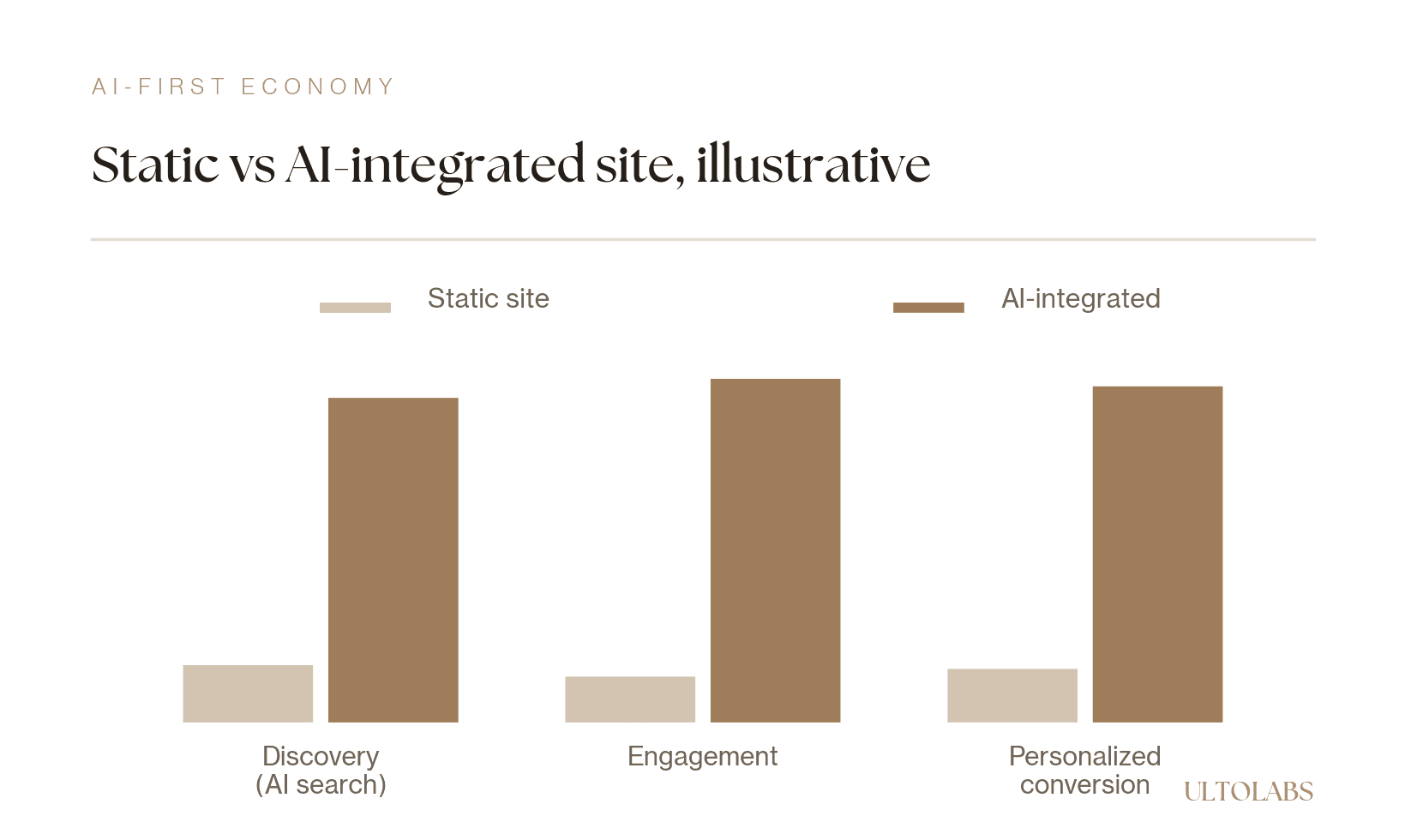
Static sites underperform AI-integrated sites across discovery, engagement, and conversion.
Why Do Static Sites Fail at Conversion?
Static sites fail at conversion because they cannot personalize or capture through conversation, and both now drive results, with personalization linked to about 40% more revenue (McKinsey, 2025). A page that shows everyone the same content and offers only a cold form converts a fraction of what a modern site does.
Conversion in an AI-first economy runs on relevance and low friction. A static site delivers neither. It shows the same message to every visitor regardless of intent, and it captures through a form that most visitors abandon. Each visitor is left to find their own path and do their own work, which most will not do.
An AI-integrated site personalizes the experience to each visitor and captures leads through conversation rather than forms. It converts more of the same traffic because it meets each visitor with relevance and help. In a market where competitors are adopting this, a static site does not just underperform. It falls behind the new baseline that buyers now measure every site against.
What Does AI Integration Now Require?
AI integration now requires three things at once: discoverability by AI answer engines, instant conversational engagement, and personalized, integrated conversion. Together these are the new baseline, not a premium tier. GCC firms already run AI agents in 86% of surveyed workflows (McKinsey, 2025), and their websites are moving the same way.
On discovery, the site must be structured so AI crawlers understand and cite it, which is the work of SEO, GEO, and AEO together. On engagement, it needs real-time conversational ability to answer visitors the instant they ask. On conversion, it must personalize by intent and capture through conversation, connected to the pipeline so leads are worked, not collected.
This is a rebuild of what a website is for, not a coat of paint. UltoWeb approaches it as an integrated system: a high-converting build, text and voice chatbot tiers, and a standalone SEO, GEO, and AEO offering that makes the site findable in an AI-first market. Static was enough for the old economy. The new one demands intelligence.
Frequently Asked Questions
Is a static website still worth having?
A static website still presents information, but in an AI-first economy it underperforms on discovery, engagement, and conversion. Buyers now expect instant answers and personalization, and they increasingly find businesses through AI assistants. A static site is a starting point that now leaves most of its potential unrealized.
What is AEO and why does it matter now?
Answer Engine Optimization structures content so AI assistants like ChatGPT and Perplexity can understand and cite it. It matters because buyers increasingly ask these assistants for recommendations. A site that is invisible to answer engines is invisible to a growing share of buyers.
Can I add AI to my existing static site?
Often yes, though the best results come from building conversion and AI discovery in rather than bolting them on. Integration matters: a disconnected widget helps little, while conversational engagement and AI-ready structure connected to your pipeline transform performance.
Does this apply to Middle East businesses specifically?
Yes, and arguably more so. GCC markets are adopting AI quickly, buyers expect bilingual instant engagement, and competitors are moving. A static site falls behind the regional baseline faster here than in slower-moving markets.
Conclusion
The web moved to an AI-first economy, and static sites were built for the one before it. They fail at discovery because AI answer engines pass them by, at engagement because they cannot respond, and at conversion because they cannot personalize or capture through conversation. This is structural, not cosmetic. The economy changed and the static site did not.
UltoWeb builds for the new baseline: findable by AI search, instantly engaging, and personalized to convert, with chatbot tiers and a standalone SEO, GEO, and AEO offering. Static was enough once. Now intelligence is the price of entry.
Sources: McKinsey Personalization Report, 2025; McKinsey GCC AI, retrieved 2026-07-10.