A website that only informs is a brochure with a URL. It tells visitors about you and leaves them to decide alone, which most never do. A high-converting AI website works: it engages every visitor, answers their questions, captures their details, and moves them toward a decision. The difference is intelligence built into the page, not bolted on as an afterthought.
This is the pillar guide for the UltoWeb cluster. It covers what makes an AI website convert, why intelligence beats static design, and how Middle East firms should approach the build. Every other Web post links back here.
Key Takeaways
McKinsey links achieving personalization to about 40% more revenue (McKinsey Personalization Report, 2025).
Conversational lead capture converts at roughly three times the rate of static forms (industry conversion research, 2025).
AI websites engage, qualify, and capture visitors instead of leaving them to act alone.
Intelligence must be integrated into the site, not added as a disconnected widget.
What Makes an AI Website "High-Converting"?
A high-converting AI website is one that actively engages, qualifies, and captures visitors rather than passively displaying information, and the revenue difference is large: McKinsey links personalization to around 40% more revenue (McKinsey Personalization Report, 2025). Intelligence turns a passive page into an active conversion system.
The distinction is behavioral. A static site waits. A visitor arrives, reads, and leaves, and the site does nothing to move them. An AI website acts. It greets the visitor, answers questions in real time, understands intent, and guides them toward the next step, whether that is booking, buying, or leaving their details. It behaves like your best salesperson, on every visit, at once.
That behavior is what conversion depends on. Most visitors will not fill a form or figure out the next step alone. An AI website removes that friction by doing the work for them: asking the right question, giving the right answer, and capturing the lead in a conversation rather than a cold form. UltoWeb builds sites this way, with chatbot tiers for text, voice, and both, plus a standalone SEO, GEO, and AEO offering.
Why Do Static Websites Convert So Poorly?
Static websites convert poorly because they put all the work on the visitor and offer no help at the moment of decision, so most visitors leave without acting. Static forms alone convert only a small share of traffic, while conversational capture converts far more (industry conversion research, 2025). The gap is the cost of passivity.
A static site is a monologue. It presents information and hopes the visitor connects the dots, finds the answer to their specific question, and decides to act, all unaided. Most do not. They have a question the FAQ does not quite answer, or a hesitation no page addresses, so they leave. The site never knew they were there and never tried to help.
This is expensive because you paid to bring that visitor. Every visitor who leaves unengaged is wasted acquisition spend. An AI website converts a meaningfully larger share of the same traffic by engaging at the decisive moment, which means your existing traffic produces more business without spending a dirham more on ads.
Our finding: In most site audits, the biggest conversion leak is not the design or the copy. It is the absence of anyone to answer the one question standing between the visitor and action.
How Does Integrated Intelligence Capture More Leads?
Integrated intelligence captures more leads by turning a static form into a conversation, and conversational capture converts at roughly three times the rate of forms (industry conversion research, 2025). Instead of asking a visitor to fill fields, it asks questions, gives value, and captures details naturally.
A form is a barrier. It demands effort upfront and offers nothing until submitted, so most visitors abandon it. A conversation is the opposite: it engages first, answers the visitor's question, and captures their details as part of a helpful exchange. The visitor gets value immediately, and the firm gets a qualified lead rather than an abandoned form.
Integration is what makes this work. The intelligence is part of the site and connected to the CRM, so a captured lead flows straight into your pipeline, routed and ready. It is not a disconnected widget that collects emails into a void. UltoWeb's chatbot tiers do exactly this, capturing and qualifying visitors in Arabic and English and passing them into your workflow.
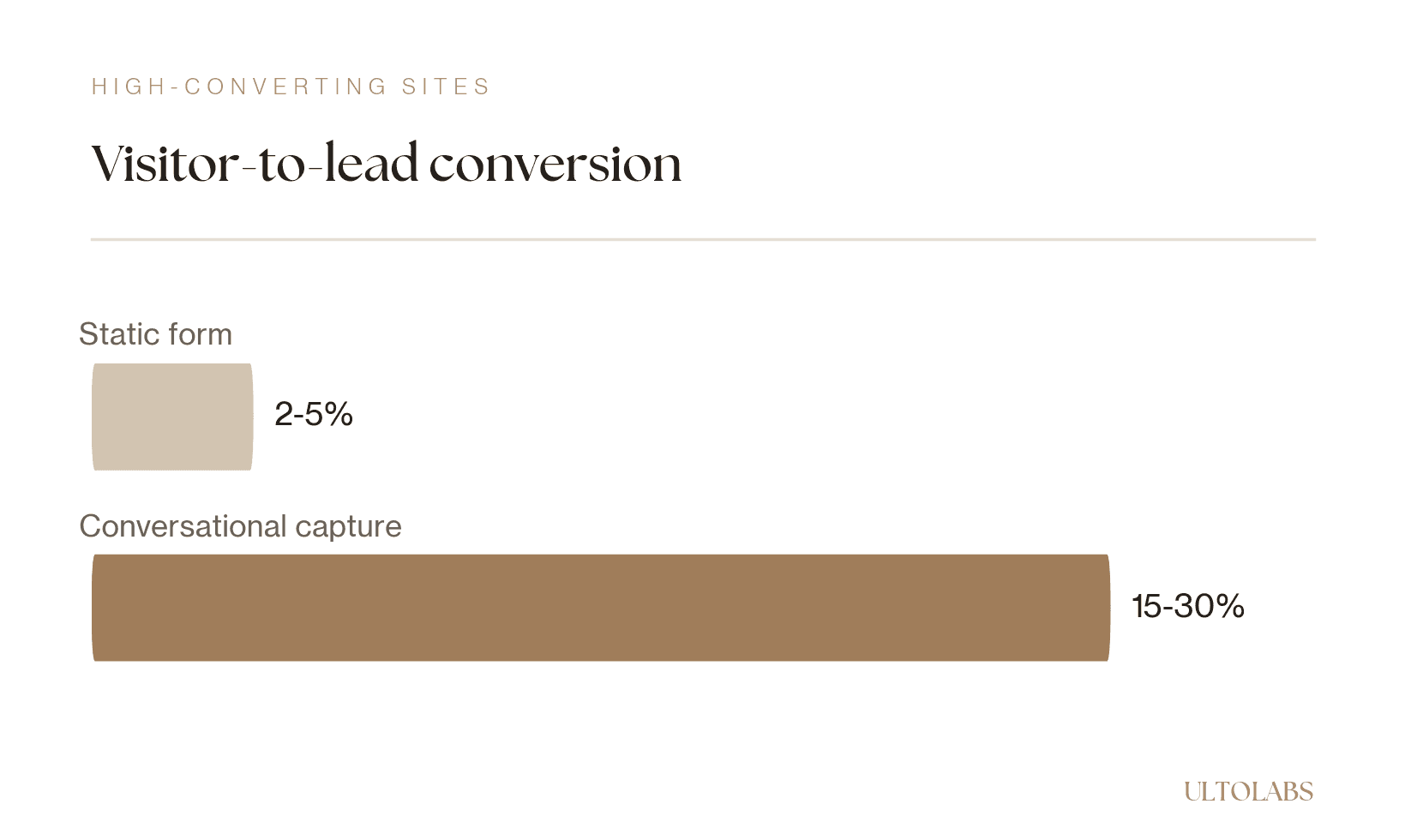
Conversational capture typically converts far more of the same traffic (industry research, 2025).
Why Does Personalization Drive Revenue?
Personalization drives revenue because visitors respond to relevance, and McKinsey links achieving personalization to about 40% more revenue (McKinsey Personalization Report, 2025). An AI website personalizes every visit automatically, which a static site cannot do at all.
A static site shows everyone the same page. A visitor looking for one service wades through content about others, and a returning visitor starts from scratch. An AI website adapts: it responds to what the visitor asks, surfaces what is relevant to them, and tailors the conversation to their intent. Every visitor gets a version of the site fitted to them.
That relevance is what lifts revenue. A visitor who quickly finds exactly what they need, answered in their language, is far more likely to act. Personalization is not a cosmetic feature. It is a conversion mechanism, and AI is what makes it possible for every visitor rather than a hand-picked few.
How Should Middle East Firms Approach an AI Website Build?
Middle East firms should approach an AI website as an integrated conversion system built around bilingual engagement and CRM connection, not as a static site with a chatbot bolted on. This integration is what separates a site that converts from one that merely looks modern. GCC firms already run AI agents in 86% of surveyed workflows (McKinsey, 2025), and the website is where many first meet a customer.
Start with the conversion job. Define what a visitor should do and what stands in their way, then build the intelligence to remove that friction: real-time answers, conversational capture, and instant routing into the CRM. Make bilingual Arabic and English engagement core, since regional visitors expect it. Connect everything, so a captured lead becomes a worked lead automatically.
Then layer in discovery. A high-converting site is worthless if no one finds it, which is why UltoWeb pairs the build with a standalone SEO, GEO, and AEO offering to win visibility across search and AI answer engines. Build the site to convert, make it findable, and connect it to the pipeline. That is the whole system.
Frequently Asked Questions
What is a high-converting AI website?
It is a website that actively engages visitors, answers their questions in real time, captures leads through conversation, and routes them into your pipeline, rather than passively displaying information. The intelligence is integrated into the site, and it typically converts far more of the same traffic than a static page.
How much better do AI websites convert than static ones?
Static forms convert a small share of visitors, while conversational capture converts several times more, and personalization is linked to around 40% more revenue in McKinsey's research. The exact lift depends on your traffic and industry, but the direction is consistent.
Does the chatbot work in Arabic and English?
Yes. UltoWeb's chatbot tiers engage visitors in Arabic, English, or both, matching how Middle East visitors actually communicate. Bilingual engagement is core, not an add-on, because it directly affects how many visitors convert.
Will an AI website help my search rankings?
The site itself converts traffic; getting traffic is a separate job. UltoWeb pairs the build with a standalone SEO, GEO, and AEO offering to win visibility across Google and AI answer engines, so the high-converting site actually gets found.
Conclusion
A website should work, not just inform. Static sites put all the effort on the visitor and lose most of them at the moment of decision. High-converting AI websites engage every visitor, answer their questions, capture their details through conversation, and route them into your pipeline, personalized and bilingual. With personalization linked to 40% more revenue, intelligence is the difference between a brochure and a salesperson.
UltoWeb builds these sites end to end, with text and voice chatbot tiers and a standalone SEO, GEO, and AEO offering so they get found. Build the site to convert, then let it work every visit.
Sources: McKinsey Personalization Report, 2025; McKinsey GCC AI, retrieved 2026-07-10. Conversion ranges reflect widely cited 2025 industry research.