A specialized clinic runs on two scarce resources: clinician time and chair time. Both are wasted when the phone goes unanswered and when booked patients do not show. Voice AI for clinics in the UAE addresses both directly. It answers every patient call, books and confirms appointments, and reminds patients in the language they prefer.
This post is written for clinic owners and managers who are tired of losing bookings to a busy front desk and empty chairs to no-shows.
Key Takeaways
A review of 105 studies found an average clinic no-show rate of 23% (PMC systematic review, 2024).
Patients overwhelmingly prefer phone and SMS reminders, chosen by about 97.2% in one study (Frontiers in Digital Health, 2025).
Voice AI answers every call, confirms bookings, and reduces no-shows without adding front-desk staff.
Bilingual Arabic and English coverage is essential for UAE clinics.
Why Do Clinics Lose So Much to Missed Calls and No-Shows?
Clinics lose heavily because two leaks compound: unanswered booking calls and patients who never arrive, and no-shows alone average 23% across specialties (PMC systematic review, 2024). Each empty chair is clinician time that cannot be recovered and a slot another patient could have filled.
The first leak is the phone. Clinic front desks are busy with patients in the room, so incoming calls ring out during exactly the hours patients want to book. A caller who cannot reach you often books with the next clinic instead. The second leak is the no-show, where a booked patient forgets or drifts and the slot dies.
These leaks feed each other. A missed call is a booking you never made. A no-show is a booking you made and lost. Voice AI attacks both: it answers the call to create the booking, then confirms and reminds to protect it. That combination is what fills the schedule.
How Does Voice AI Reduce Clinic No-Shows?
Voice AI reduces no-shows by confirming and reminding patients through the channels they actually respond to, and patients strongly prefer phone and SMS, chosen by roughly 97.2% in one study (Frontiers in Digital Health, 2025). Automated, well-timed contact is what turns a booking into an arrival.
The agent calls or messages to confirm at booking, reminds ahead of the appointment, and makes rescheduling effortless. A patient who cannot make the slot can move it in seconds rather than simply not showing. That single feature converts silent no-shows into filled alternative slots.
Timing and language do the rest. Reminders land when patients can act on them, in Arabic or English, with a clear option to confirm, cancel, or rebook. Every rebooked slot is chair time recovered and a patient kept. Over a month, cutting even a portion of a 23% no-show rate is a measurable gain in clinician utilization.
Our finding: In clinics, the highest-value automation is often not the booking itself but the confirmation and reschedule loop, because that is where filled chairs are won or lost.
What Can a Clinic Voice Agent Handle During a Call?
A clinic voice agent handles the full patient-facing call: booking, rescheduling, reminders, directions, and routing clinical questions to staff. In the GCC, 86% of surveyed organizations already run AI agents in daily workflows (McKinsey, 2025), and healthcare front-desk work is a natural fit.
A well-built clinic agent covers:
Booking new appointments directly into the clinic calendar, by specialty and clinician.
Rescheduling and cancellations, with the freed slot released for rebooking.
Confirmations and reminders by call or SMS, timed to reduce no-shows.
Answering routine questions about hours, location, parking, and preparation instructions.
Routing clinical or sensitive questions to the right staff member, with context.
The agent does not give medical advice. It handles logistics, which is most of the front-desk workload, and hands anything clinical to a human. That boundary keeps patients safe and staff focused on care rather than the phone.
Why Is Bilingual Coverage Non-Negotiable for UAE Clinics?
Bilingual coverage is non-negotiable because UAE patients switch between Arabic and English within a single call, and a clinic that cannot follow loses the booking. A voice agent handles both fluidly, so no patient is turned away by a language gap.
The UAE patient base is diverse. A booking line that serves only one language forces some patients to struggle or give up. An agent that greets in Arabic, takes details in English, and confirms in Arabic feels natural to every caller. That inclusiveness widens the clinic's reach and protects its reputation.
Language also affects reminders. A confirmation a patient can read and understand is one they act on. Sending reminders in the patient's preferred language raises response rates, which feeds directly back into lower no-shows. For a UAE clinic, bilingual capability is not a nice extra. It is core to filling the schedule.
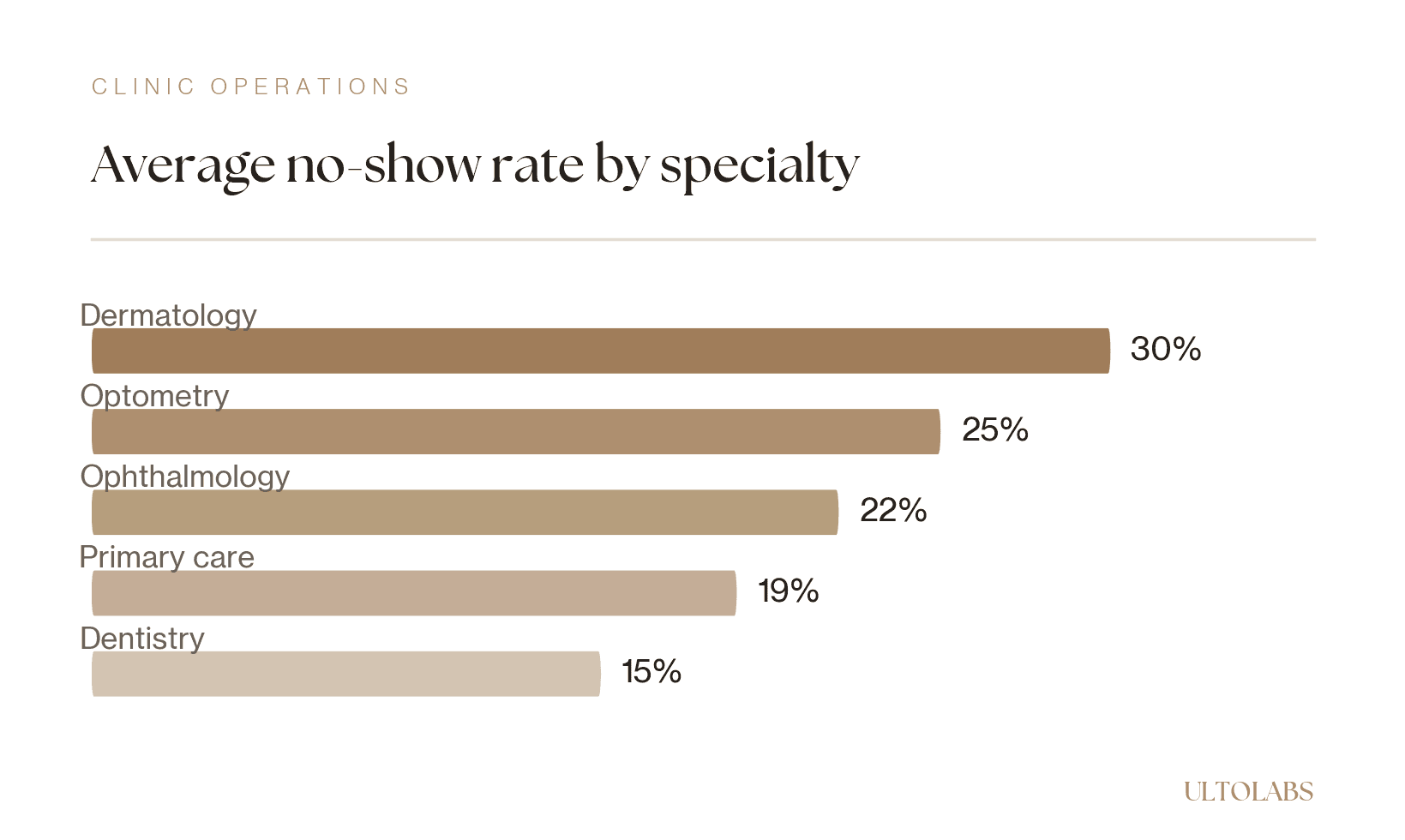
Average no-show rates by specialty (Dialog Health summary of 2025 data).
How Do You Roll Out Voice AI in a Live Clinic?
You roll out voice AI in a live clinic by starting with overflow and reminders, then expanding to primary booking once accuracy is proven. This staged approach protects patient trust and lets staff adjust. GCC firms that scale AI well tend to sequence deliberately, since only 31% have fully deployed despite 84% adoption (McKinsey, 2025).
Begin where the risk is lowest. Let the agent catch after-hours and overflow calls, and run confirmation and reminder messages. These are pure gains: calls the desk would have missed and no-shows it would not have prevented. Staff see the schedule fill without any disruption to their day.
Once the agent proves it books accurately and routes clinical questions correctly, expand it to daytime overflow and then to primary answering for booking-type calls. Review transcripts weekly at first, correct the agent's knowledge where it stumbled, and refine the reminder timing. Within weeks, the front desk is calmer, the phone is always answered, and the chairs are fuller.
Frequently Asked Questions
Does voice AI give medical advice to patients?
No. A clinic voice agent handles logistics like booking, reminders, and directions, and routes any clinical or sensitive question to qualified staff. That boundary keeps patients safe and keeps the clinic compliant with its own care protocols.
How much can it reduce no-shows?
Results vary by specialty and patient base, but with average no-show rates near 23% and patients strongly preferring phone and SMS reminders, a consistent confirmation and reschedule loop recovers a meaningful share of otherwise-empty slots.
Can it work with our existing clinic calendar?
Yes. A custom agent connects to your booking system so appointments, reschedules, and cancellations sync automatically. The freed slots from cancellations are released for rebooking rather than lost.
Is patient data handled responsibly?
A properly deployed agent follows your clinic's data rules and routes sensitive matters to staff. Data handling should be scoped and agreed during setup, matching your existing patient-privacy standards.
Conclusion
Specialized clinics cannot afford to lose bookings to a busy phone or chairs to no-shows. Voice AI for clinics in the UAE closes both leaks: it answers every call to create the booking, then confirms and reminds to protect it, in Arabic and English. With no-show rates averaging 23%, that loop is one of the highest-return systems a clinic can add.
UltoVoice is built to handle clinic front-desk logistics while your team focuses on care. Start with reminders and overflow, watch the schedule fill, then expand.
Sources: PMC systematic review of no-show rates, 2024; Frontiers in Digital Health, 2025; Dialog Health no-show statistics, 2025; McKinsey GCC AI.