Capturing a lead is the easy part. Most captured leads are not ready to buy today, and firms treat that as failure instead of timing. They chase the ready few and let the rest go cold, throwing away the majority of the demand they paid to create. Intelligent lead nurturing fixes this. It keeps every lead warm with relevant, timely contact and converts them when they are ready, not when it is convenient.
This post covers how AI lead nurturing works across the Middle East, and why it recovers the leads most firms waste. It bridges the Flow and Web clusters and links to the workflow automation pillar.
Key Takeaways
Most leads are not ready to buy on first contact, so nurturing decides how many you eventually convert.
78% of buyers choose the first firm to respond, but the rest convert later with good nurturing (speed-to-lead research, 2025).
Intelligent nurturing personalizes contact by behavior and readiness, in Arabic and English.
GCC organizations run AI agents in 86% of surveyed workflows (McKinsey, 2025).
Why Are Most Captured Leads Wasted?
Most captured leads are wasted because firms only work the ones ready to buy now and abandon the rest, even though the majority convert later with the right nurturing. Since 78% of buyers reward the first responder (speed-to-lead research, 2025), firms over-focus on speed and neglect the slower-burning majority.
The pattern is common. A batch of leads comes in. A few are ready and get worked hard. The rest do not respond immediately, so reps deprioritize them and chase fresh leads instead. Those deprioritized leads were not lost causes. They were simply not ready yet, and with no nurturing they go cold and eventually buy elsewhere.
This is expensive waste. You paid to capture every one of those leads. Letting the not-ready-yet majority slip means paying for demand and then discarding most of it. Nurturing recovers that value by staying in touch until the timing is right, turning a one-shot process into a long-term conversion engine.
What Makes Lead Nurturing "Intelligent"?
Lead nurturing is intelligent when it adapts contact to each lead's behavior and readiness, rather than sending everyone the same generic drip. This behavioral responsiveness is what separates modern nurturing from an old-fashioned email blast, and it depends on the interpretive AI that GCC firms now run in 86% of workflows (McKinsey, 2025).
A generic drip treats every lead identically, which means it is wrong for most of them. Intelligent nurturing reads signals: what the lead viewed, whether they opened or replied, how they behave, and adjusts. A lead showing buying signals gets moved toward a sales conversation. A lead going quiet gets a re-engagement touch. The content and timing match the person.
This responsiveness is what makes nurturing feel relevant rather than spammy. The lead receives messages that fit where they actually are, not a fixed sequence indifferent to their behavior. Relevance is what keeps them engaged, and engagement is what carries them to conversion when their timing finally arrives.
Our finding: The difference between nurturing that converts and nurturing that annoys is almost entirely relevance. The same message is welcome to a warm lead and spam to a cold one. Intelligence is knowing which is which.
How Does Intelligent Nurturing Move Leads to Conversion?
Intelligent nurturing moves leads to conversion by keeping them engaged with relevant contact and detecting the moment their readiness rises, then handing them to sales. It bridges the long gap between capture and purchase that most firms fail to cover.
The mechanism is continuous and adaptive. The system stays in touch across channels, delivering value and staying present without nagging. It watches for readiness signals: increased engagement, a return visit, a direct question. When those signals appear, it escalates, moving the lead toward a sales conversation while intent is high and handing off to a rep with full context.
This is how the not-ready-yet majority becomes revenue. Instead of being abandoned, they are carried through their decision process at their own pace, then caught at the exact moment they are ready. The firm that nurtures well converts leads its competitors already gave up on.
Stays present with relevant, valued contact across channels.
Reads engagement and behavior to gauge readiness.
Escalates leads showing buying signals toward sales.
Re-engages leads going quiet before they go cold.
Hands ready leads to a rep with full context.
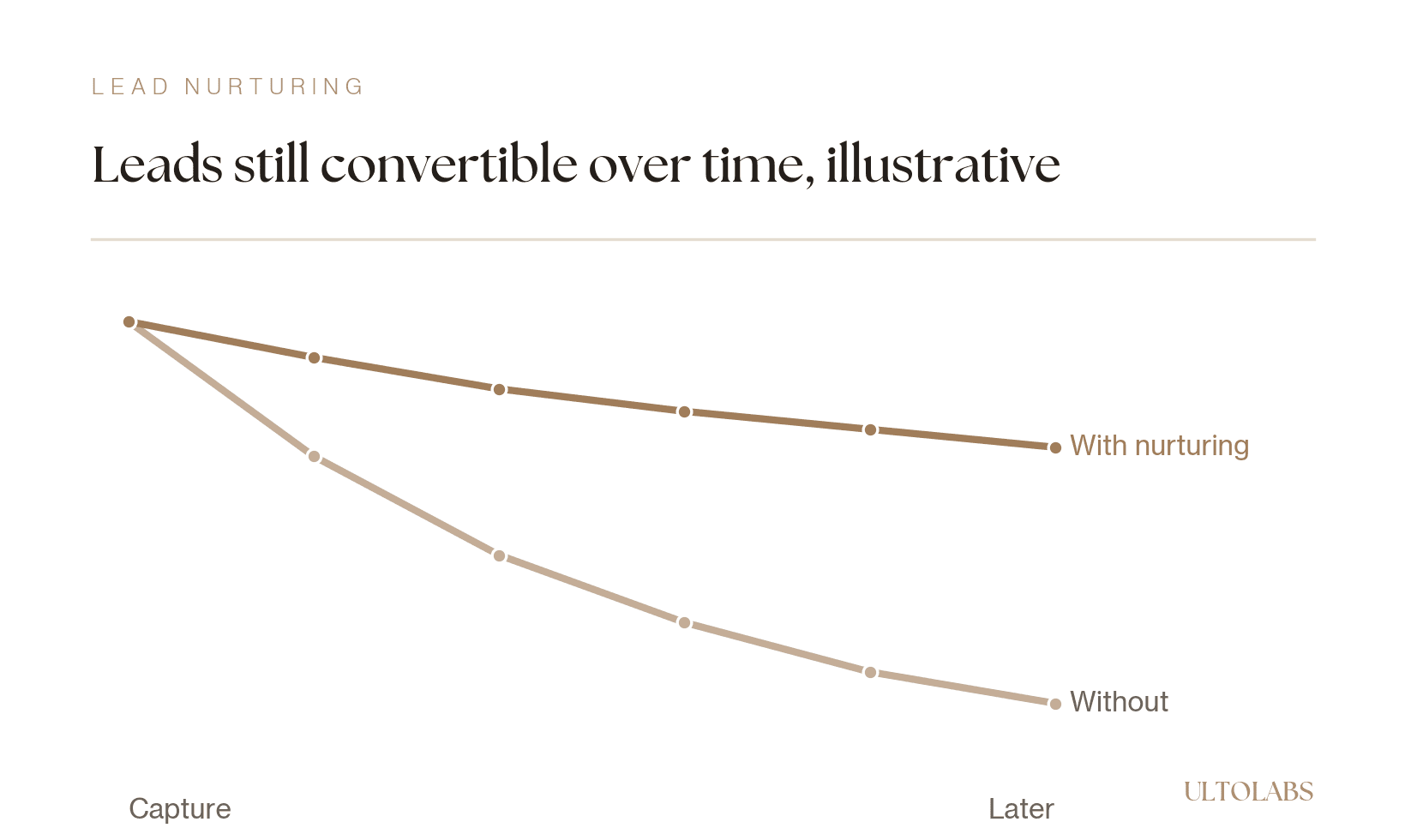
Nurturing keeps leads convertible long after unattended leads go cold.
Why Does Nurturing Need Arabic and English?
Nurturing needs Arabic and English because Middle East leads engage in both, and a message in the wrong language reads as generic and gets ignored. Relevance includes language, and intelligent nurturing delivers each lead the language they respond to.
A nurture sequence only works if the lead actually reads and engages with it. A message in a language the lead is less comfortable with lowers engagement and signals that the firm does not really see them. Matching language to the lead raises open and reply rates, which feeds directly into conversion.
Bilingual nurturing also widens the pool you can convert. You stop losing the leads who would have engaged in Arabic but received only English, or the reverse. Every lead gets a sequence that fits them, which is the entire premise of intelligent nurturing applied to the reality of the regional market.
How Do You Build a Nurturing System That Works?
You build a nurturing system that works by unifying your leads, defining readiness signals, and letting AI adapt contact by behavior, then handing off to sales at the right moment. This turns a scattered pile of captured leads into a managed conversion pipeline.
Start by bringing every lead into one system with its source and behavior attached, so nurturing has the signals it needs. Define what readiness looks like for your business: the behaviors and engagement that mean a lead is warming. Then let the system deliver relevant, adaptive contact across channels in the right language, escalating leads as they heat up.
Measure engagement, re-engagement, and eventual conversion of nurtured leads. Refine the content and timing as you learn what moves your audience. Over time, the not-ready-yet leads that competitors abandon become a steady, compounding source of conversions, worked automatically until each one is ready.
Frequently Asked Questions
What is intelligent lead nurturing?
It is a system that keeps captured leads engaged with relevant, adaptive contact based on their behavior and readiness, then hands warm leads to sales. Unlike a fixed drip, it adjusts content, timing, and language to each lead, so nurturing feels relevant rather than generic.
Why not just focus on leads ready to buy now?
Because most leads are not ready on first contact, and abandoning them wastes demand you already paid to capture. The ready-now leads are a minority. Nurturing converts the larger group that buys later, which is where most recoverable revenue sits.
Does it work over WhatsApp?
Yes. Intelligent nurturing runs across WhatsApp, email, and other channels in Arabic and English, meeting Middle East leads where they engage. WhatsApp nurturing in particular tends to see strong response in the region.
When does a salesperson get involved?
The moment a lead shows real buying signals. The system detects rising readiness and hands the lead to a rep with full context, so the conversation is warm and well-timed. Automation handles the long nurture; humans handle the close.
Conclusion
Capturing a lead is not converting it. Most leads are not ready today, and firms that abandon the not-ready-yet majority waste most of the demand they paid for. Intelligent lead nurturing recovers that value by staying relevant, adapting to behavior, and converting each lead when their timing arrives, in Arabic and English.
UltoFlow and UltoWeb combine to capture leads and nurture them from first touch to conversion. Stop discarding the leads that were simply not ready yet, and turn them into a compounding source of revenue.
Sources: Speed-to-lead statistics, 2025; McKinsey GCC AI, retrieved 2026-07-10.