A content pipeline is not a writing tool. It is the whole assembly line: plan, produce, refine, publish, repeat, running reliably enough that content never stops. Most brands have the tool and not the pipeline, which is why their output is sporadic and their authority stalls. This is a practical guide to building an automated marketing content generator that produces on-brand content at a pace manual effort cannot hold.
It is the how-to companion to the UltoStudio pillar on AI content production systems. Read that for the strategy; read this for the build.
Key Takeaways
Companies publishing 16 or more posts monthly see around 4.5x more leads than low-volume publishers (widely cited content-marketing research, 2025).
A pipeline covers plan, produce, refine, and publish, not just drafting.
Automation sustains a pace and consistency that manual production cannot match.
Build the pipeline around your brand voice and strategy, then scale the volume.
What Is an Automated Content Pipeline?
An automated content pipeline is an end-to-end system that plans, produces, refines, and publishes content on a reliable schedule, rather than a tool that writes one draft at a time. The payoff is volume with consistency, and high-volume publishers see around 4.5x more leads (widely cited content-marketing research, 2025).
Think of it as an assembly line. Raw strategy goes in one end, and finished, published, on-brand content comes out the other, on schedule. Each stage, planning topics, producing drafts, refining to standard, and publishing, is a station in the line, and automation keeps the line moving without a person carrying each piece by hand.
This is fundamentally different from a writing tool. A tool produces a draft and stops, leaving planning, refinement, and publishing to you. A pipeline handles the full journey, so content flows continuously instead of appearing whenever someone finds time. That continuous flow is what sustains the volume and consistency authority requires.
What Are the Stages of a Content Pipeline?
The stages of a content pipeline are plan, produce, refine, and publish, and automating each is what turns sporadic output into a reliable stream. Most brands automate only the produce stage and wonder why output stays inconsistent. GCC firms run AI agents across 86% of surveyed workflows (McKinsey, 2025), and content is a natural fit.
Each stage does a specific job:
Plan: map topics to your strategy, funnel, and audience, so content is purposeful.
Produce: generate drafts in your brand voice, at the required volume.
Refine: hold quality to a consistent standard before anything ships.
Publish: schedule and distribute reliably, so cadence never slips.
The stages that brands skip are usually plan and refine, which are exactly the ones that determine whether volume builds authority or just noise. A pipeline that produces without planning creates content nobody needs. One that produces without refining ships inconsistent quality. Automating all four stages is what makes the pipeline actually work.
How Does Automation Sustain the Pace?
Automation sustains the pace by removing the human bottleneck at each stage, so output does not depend on anyone finding time. This is what lets a brand reach the volume that drives results: high-volume publishers see roughly 4.5x more leads (widely cited content-marketing research, 2025), a pace manual teams rarely hold.
Manual production is capped by human capacity. Every stage waits on a person, so a busy week stalls the whole line and output becomes sporadic. That sporadic pattern is fatal to authority, which depends on consistency. Automation removes the wait: planning, producing, and refining run on the system's schedule, not on whether someone had a free afternoon.
The result is a pace that holds through busy periods and quiet ones alike. The pipeline produces on plan, week after week, so your presence never goes dark. That reliability is the entire advantage, because it converts the theoretical benefit of high-volume publishing into an actual, sustained output your competitors relying on manual effort cannot match.
Our finding: Brands rarely fail at content because they cannot write. They fail because writing competes with everything else for the same scarce hours, and content always loses. Automation ends that competition.
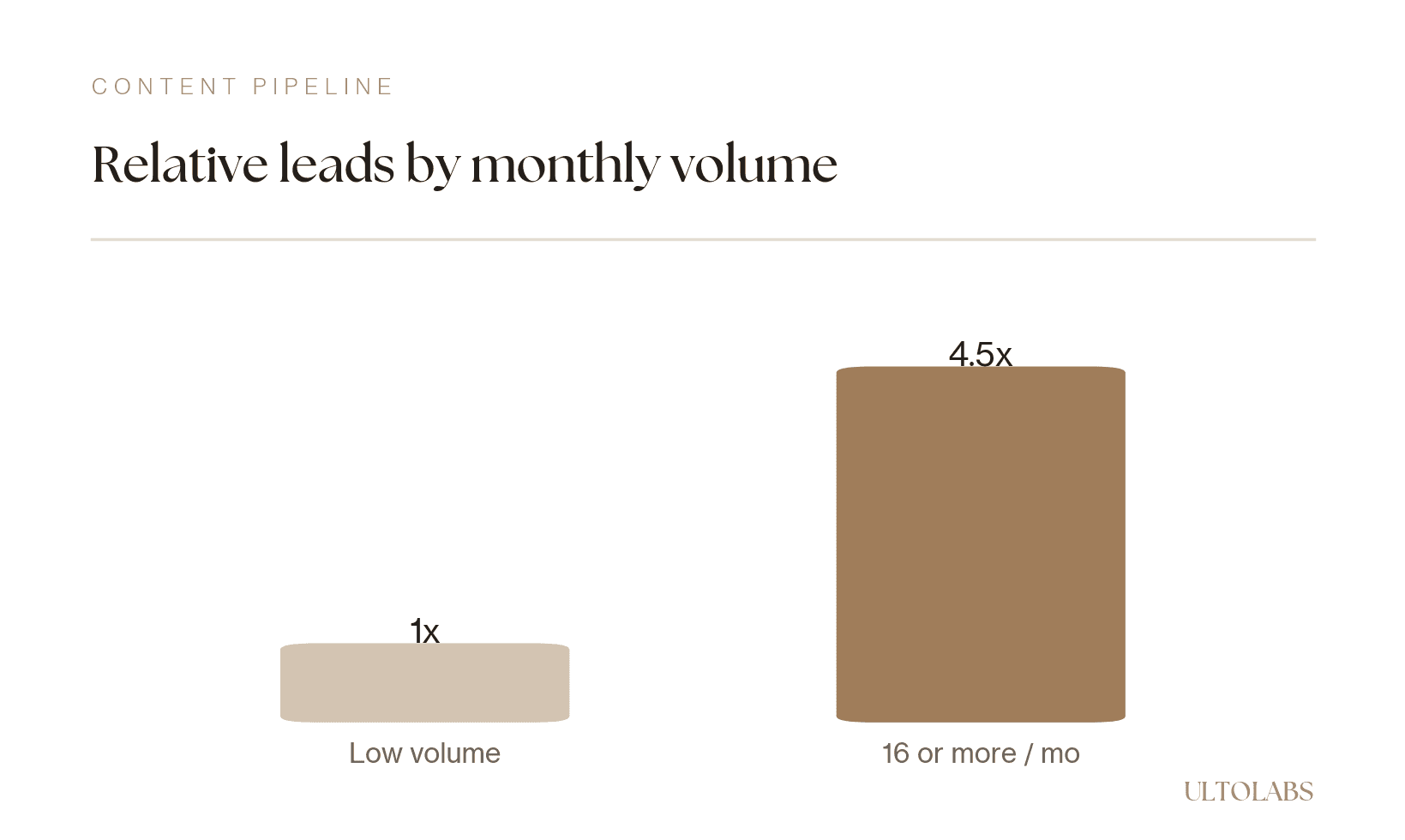
High-volume publishing is associated with far more leads (2025 research).
How Do You Keep an Automated Pipeline On-Brand?
You keep an automated pipeline on-brand by encoding your voice and standards into the produce and refine stages, so consistency is built in rather than checked after. This is what prevents volume from turning into generic noise, and it is the difference between a pipeline and a spam machine.
The safeguard is the brand voice standard. Before the pipeline produces anything, your voice, positioning, and quality bar are defined and encoded, so every piece is produced against them and refined to meet them. The consistency is not policed manually at the end; it is designed into the line. That is how a large volume of content still reads as one coherent brand.
Strategy provides the second safeguard. Because the plan stage maps content to your funnel and goals, the pipeline produces content that serves a purpose, not filler to hit a number. Volume with voice and strategy is authority. Volume without them is noise. UltoStudio builds pipelines with both encoded, so scale and quality rise together.
How Do You Build Your Pipeline Step by Step?
You build your pipeline by defining voice and strategy first, automating one stage at a time, and scaling volume as consistency proves out. This disciplined build mirrors how GCC firms move from AI adoption to real scale (McKinsey, 2025).
Start with the foundation: a documented brand voice and a content strategy mapping topics to your funnel. Without these, automation just produces faster noise. Next, automate the produce stage against that foundation, then add refine so quality holds, then plan so topics stay purposeful, then publish so cadence never slips. Building stage by stage lets you confirm each works before adding the next.
Then scale the volume toward the pace your goals require, knowing content ROI compounds over time. Measure output consistency, quality, traffic, and leads, and refine as you learn. Built this way, the pipeline becomes a reliable engine that produces on-brand content at a pace manual effort cannot, turning content from a chore into a compounding asset. UltoStudio delivers this across Starter, Growth, and Enterprise tiers.
Frequently Asked Questions
What is an automated marketing content generator?
It is a pipeline that plans, produces, refines, and publishes content on a reliable schedule, not just a tool that writes drafts. By automating each stage, it sustains the volume and consistency that build authority, keeping brand voice and quality intact.
How much content should I aim to publish?
Volume matters, with high-volume publishers seeing several times more leads, but consistency matters more than any single number. The right pace depends on your goals and stage. The key is a reliable cadence the pipeline can sustain, rather than sporadic bursts.
Won't automated content all sound the same?
Not when your brand voice is encoded into the produce and refine stages. A well-built pipeline holds a consistent voice across volume, which reads as a coherent brand. Sameness in a bad way comes from generic tools without encoded standards, not from automation itself.
Can the pipeline publish in Arabic and English?
Yes. An automated pipeline can produce and publish on-brand content in Arabic, English, or both, matching how Middle East audiences consume content. Bilingual output widens the reach of the authority the pipeline builds.
Conclusion
A content pipeline is the assembly line that turns strategy into published authority, reliably and on-brand. Most brands own the writing tool and lack the pipeline, so their output is sporadic and their authority stalls. Automating all four stages, plan, produce, refine, and publish, sustains the pace and consistency that manual effort cannot, and high-volume publishing drives far more leads.
UltoStudio builds these pipelines with your voice and strategy encoded, across Starter, Growth, and Enterprise tiers. Define your foundation, automate stage by stage, and turn content into a compounding engine.
Sources: McKinsey GCC AI, retrieved 2026-07-10. Content-marketing figures reflect widely cited 2025 research.