Generic AI writing tools solved the easy problem: producing a draft. They left the hard problems untouched. Brand consistency across hundreds of pieces, strategy-driven planning, and a production system that runs without a person steering every step. If you are evaluating Jasper AI for business content and finding it useful but shallow, that is why. This post explains where generic tools stop and custom engines take over.
It is a comparison piece, honest about what generic tools do well and clear about where they fall short. It builds on the UltoStudio pillar on AI content production systems.
Key Takeaways
Generic tools like Jasper produce drafts well but do not build production systems.
Custom engines encode brand voice, strategy, and workflow, so content is consistent and on-strategy at scale.
Consistent, strategic publishing drives far higher ROI than sporadic output (widely cited content-marketing research, 2025).
The real competition is not draft quality; it is systematic, on-brand production at volume.
What Do Generic AI Writing Tools Do Well?
Generic AI writing tools do one thing well: they turn a prompt into a competent draft quickly, which is genuinely useful for one-off writing. Dismissing that would be unfair, since content marketing already returns roughly 3 dollars per dollar invested and these tools lower the cost of a first draft (widely cited research, 2025).
For an individual writing a single blog post, a social caption, or an email, a tool like Jasper is fast and helpful. It removes the blank-page problem and produces usable text in minutes. That is a real gain, and for occasional, standalone content it may be all a person needs. The mistake is expecting it to do more than draft.
Because the moment the need is systematic, the tool's limits appear. Producing one good draft is not the same as running consistent, on-brand production across a whole content strategy. Generic tools are built for the first job and not the second, which is exactly where brands scaling authority feel the ceiling.
Where Do Generic Tools Hit Their Ceiling?
Generic tools hit their ceiling at consistency, strategy, and workflow, because they produce drafts in isolation with no system around them. This matters because consistent, strategic publishing is what drives results, with regular publishers seeing far higher ROI than sporadic ones (widely cited content-marketing research, 2025).
The first ceiling is brand consistency. A generic tool produces whatever each prompt asks, so across hundreds of pieces and multiple people the voice drifts. There is no enforced brand standard, only individual prompts. The second is strategy: the tool writes what you ask, but it does not plan what you should write, map content to your funnel, or keep production aligned to goals. That thinking stays manual.
The third ceiling is workflow. A draft is one step; production is a pipeline of planning, producing, refining, and publishing consistently. Generic tools hand you a draft and leave the rest to you, which means the bottleneck simply moves to the human steering the tool. At volume, that human becomes the constraint, and the promised scale never arrives.
Our finding: Brands that rely on a generic tool for serious content usually discover the tool was never the bottleneck. The bottleneck was the person orchestrating it, and a tool that only drafts does nothing to relieve that.
How Does a Custom AI Engine Solve These Problems?
A custom AI content engine solves these problems by building brand voice, strategy, and workflow into the system, so consistent, on-strategy content is produced at volume without a person steering each step. This is the difference between a tool and a system, and it is why GCC firms run AI agents across 86% of surveyed workflows (McKinsey, 2025).
On consistency, a custom engine encodes your brand voice as a standard every piece follows, so the hundredth article sounds like the first. On strategy, it plans topics against your funnel and goals, producing content that advances the strategy rather than random drafts. On workflow, it runs the whole pipeline, from plan to refined output, so production does not depend on a person driving each step.
The engine is also tuned to your business: your positioning, your audience, your languages, your topics. It is not a general tool you bend to your needs but a system shaped around them. UltoStudio is built this way, delivering strategy-aligned, on-brand production across Starter, Growth, and Enterprise tiers rather than isolated drafts.
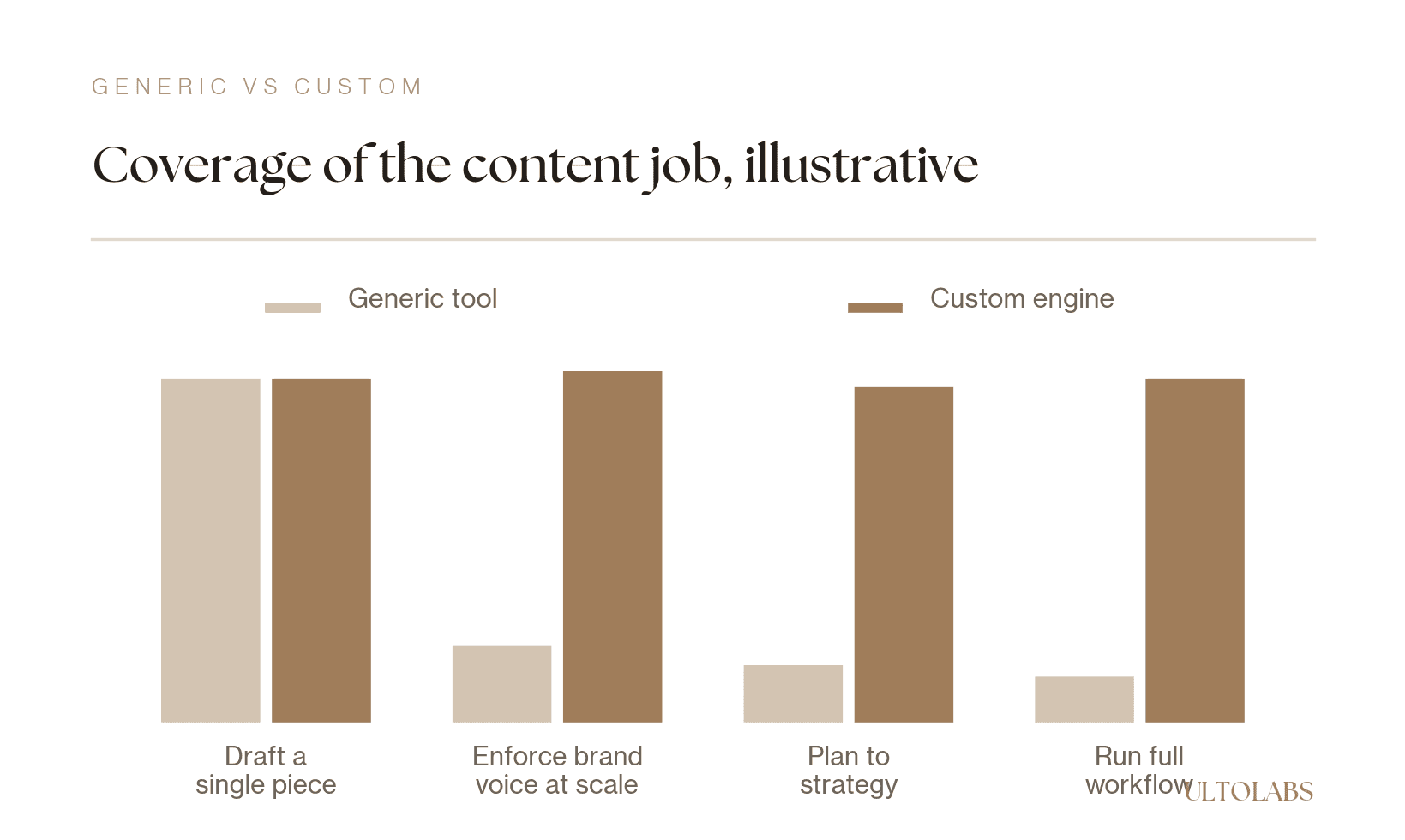
Generic tools cover drafting; custom engines cover the full production job.
Why Does On-Brand Consistency Matter So Much?
On-brand consistency matters because a large body of content only builds authority if it reads as one confident brand, and drift undermines the trust that consistency is meant to create. Since active blogs drive around 67% more leads (widely cited research, 2025), the content has to be coherent enough to convert that traffic.
Imagine a hundred articles that each sound slightly different: different tone, different positioning, different quality. Readers sense the incoherence, and it reads as a brand that is not sure who it is. The volume that should have built authority instead dilutes it. Consistency is what makes a body of content feel authoritative rather than assembled.
A custom engine holds that consistency by design, because every piece runs through the same encoded voice and standards. This is where generic tools, driven by individual prompts, cannot compete. For a Middle East brand building authority in a competitive market, that coherence across bilingual content at volume is exactly what separates a trusted voice from noise.
How Should a Brand Choose Between Generic and Custom?
A brand should choose based on whether its content need is occasional or systematic: generic tools for one-off drafts, a custom engine for consistent, strategic production at scale. This framework prevents both overbuilding and outgrowing your tools, the same logic that governs custom versus off-the-shelf everywhere.
Use this test. If you need the occasional draft and no real consistency or strategy demands, a generic tool is fine and cost-effective. Do not build custom for that. If you are scaling authority, publishing consistently across a strategy, and need brand coherence across high volume in multiple languages, a custom engine is the durable choice.
Most serious brands cross that line sooner than they expect, usually when the person orchestrating the generic tool becomes the bottleneck. At that point, more prompting does not help; a production system does. UltoStudio provides that system, so content scales with your ambition rather than stalling at the limit of manual steering.
Frequently Asked Questions
Is Jasper or a similar tool bad for business content?
No. For occasional, standalone drafts, generic tools are fast and useful. They become limiting when the need is systematic, because they draft in isolation without enforcing brand consistency, planning to strategy, or running a full production workflow. The issue is fit, not quality.
What does a custom AI content engine add?
It adds the system around the draft: encoded brand voice for consistency, strategy-driven planning, and a full production workflow. This lets a brand produce consistent, on-strategy content at volume without a person steering each piece, which generic tools cannot do.
Will custom content still sound human and on-brand?
Yes, and more consistently than generic tools, because your brand voice is encoded as a standard every piece follows. The result reads as one coherent brand across high volume, rather than the drift that comes from individual prompts written by different people.
When is it worth moving beyond a generic tool?
When content becomes systematic: consistent publishing to a strategy, brand coherence across volume, and production that no longer fits one person's capacity. That is usually when the person running the generic tool becomes the bottleneck, and a production system is the fix.
Conclusion
Generic AI tools solved drafting and stopped there. The hard problems of serious content, brand consistency at scale, strategy-driven planning, and a production workflow that runs without a person steering each step, are exactly where they hit their ceiling. Custom AI engines are built for those problems, which is why they dominate when a brand moves from occasional posts to systematic authority.
UltoStudio delivers that engine: consistent, on-brand, on-strategy production across Starter, Growth, and Enterprise tiers, in Arabic and English. Use a generic tool for the occasional draft, and a custom engine when content becomes the strategy.
Sources: McKinsey GCC AI, retrieved 2026-07-10. Content-marketing figures reflect widely cited 2025 research.