Authority is not won by a brilliant post. It is won by showing up consistently, for months, with content good enough to trust. That is exactly what most brands cannot sustain, because content production depends on scarce time and stalls the moment things get busy. AI content production systems remove that dependency. They produce consistent, on-brand content at a pace no manual team can hold, so authority compounds instead of stalling.
This is the pillar guide for the UltoStudio cluster. It covers what an AI content production system is, why consistency builds authority, and how brands should approach it. Every other Studio post links back here.
Key Takeaways
Companies maintaining regular publishing schedules see up to 13x more positive ROI than irregular publishers (widely cited content-marketing research, 2025).
Active blogs drive around 67% more leads than non-blogging competitors (widely cited research, 2025).
AI content production systems sustain consistency that manual teams cannot, without sacrificing brand voice.
Authority is a compounding asset built by showing up, not a one-time campaign.
What Is an AI Content Production System?
An AI content production system is a structured engine that plans, produces, and refines on-brand content at scale, rather than a single tool that writes a draft. It replaces the fragile manual process that stalls under pressure, and consistency matters because regular publishers see up to 13x more positive ROI (widely cited content-marketing research, 2025).
The word "system" is the point. A writing tool gives you a draft and leaves the rest to you: the planning, the brand consistency, the volume, the refinement. A production system handles the whole pipeline. It plans topics around your strategy, produces content in your voice, keeps quality consistent, and sustains a pace that manual effort cannot. The output is a steady stream, not a sporadic burst.
This matters because authority is built by consistency, and consistency is exactly where manual production fails. A busy month, a departing writer, a competing priority, and the content stops. A system does not have busy months. It produces on schedule, in your voice, so your presence never goes quiet. UltoStudio delivers this across Starter, Growth, and Enterprise tiers.
Why Does Consistency Build Authority?
Consistency builds authority because trust accrues through repeated, reliable presence, and the data is stark: regular publishers see up to 13x more positive ROI than irregular ones, and active blogs drive around 67% more leads (widely cited content-marketing research, 2025). Showing up beats showing off.
Authority is cumulative. One excellent article does little on its own. A steady stream of useful content, published reliably over months, signals expertise to both readers and search engines. It is the difference between a brand that appears occasionally and one that is always present in its category. Readers come to expect you, and expectation is the seed of trust.
Search and AI discovery reward the same behavior. Consistent publishing builds topical depth, which is what ranking and citation increasingly depend on. A brand that publishes weekly builds authority that compounds, while one that publishes sporadically keeps starting over. The compounding is the whole prize, and only consistency unlocks it.
Our finding: The brands that dominate a category rarely have the single best piece of content. They have the deepest and most consistent body of it, built over time while competitors published in bursts and gave up.
How Does an AI System Sustain Quality at Volume?
An AI content production system sustains quality at volume by encoding your brand voice, strategy, and standards into the pipeline, so every piece meets the bar without a person rewriting it. This is what separates a system from a tool, and it is why 74% of marketers credit content for demand generation (widely cited research, 2025).
Quality at volume is the hard problem manual teams cannot solve. More content usually means thinner content, because human capacity is fixed. A production system breaks that trade-off by building quality into the process: a defined brand voice the content follows, a strategy that guides topics, and a refinement step that holds standards. Volume rises without quality falling.
The system also stays coherent. Every piece reflects the same voice, the same positioning, and the same strategy, because they all run through the same engine. A manual team drifts as different writers and moods produce different results. A system holds the line, which is what makes a large body of content feel like one confident brand rather than a patchwork.
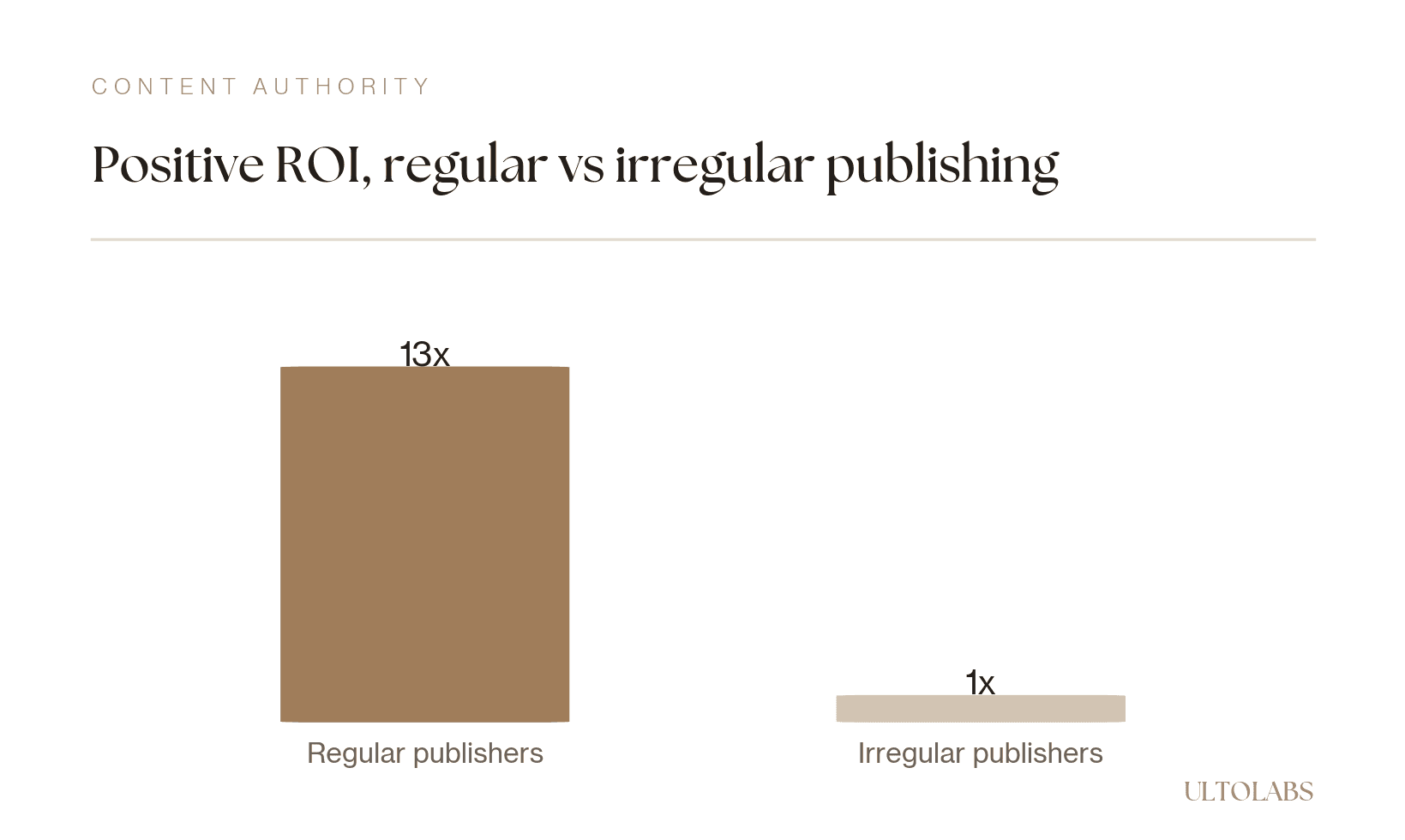
Consistent publishing sharply outperforms sporadic publishing on ROI (2025 research).
How Does Content Production Support the Whole Funnel?
Content production supports the whole funnel by feeding discovery, nurturing, and conversion with a steady supply of relevant material, so every stage has what it needs. A production system makes this sustainable, and content marketing returns roughly 3 dollars for every dollar invested across B2B (widely cited research, 2025).
At the top, consistent content drives discovery: it builds the search and AI visibility that brings new audiences in. In the middle, it nurtures: educational and trust-building material keeps prospects engaged while they decide. At the bottom, it converts: case studies, comparisons, and specific answers move ready buyers to act. A funnel starved of content leaks at every stage.
Manual production cannot feed all three consistently, so most brands over-produce for one stage and starve the others. A system produces across the funnel on plan, so discovery, nurturing, and conversion all stay supplied. That balance is what turns content from scattered posts into a machine that moves people from stranger to customer.
How Should a Brand Approach an AI Content System?
A brand should approach an AI content system by defining its voice and strategy first, then building production around them and scaling the volume to its stage. This ensures the system produces the right content consistently, not just more content. GCC firms already run AI agents in 86% of surveyed workflows (McKinsey, 2025).
Start with the foundation: a clear brand voice and a content strategy that maps topics to your funnel and your audience. These are what the system produces against, so they must be defined well. Then build production to run against that foundation, at a volume matched to your goals, from a steady Starter cadence to an Enterprise pace.
Measure what authority actually produces: visibility, traffic, leads, and eventually conversion, knowing that content ROI compounds over months. Refine the strategy as you learn what resonates. Approached this way, the system does not just publish. It builds a compounding authority asset, in your voice, at a pace your competitors relying on manual effort cannot match. UltoStudio is built to run exactly this.
Frequently Asked Questions
What is an AI content production system?
It is a structured engine that plans, produces, and refines on-brand content at scale, handling the whole pipeline rather than just writing drafts. It sustains the consistent publishing that builds authority, keeping brand voice and quality intact across high volume.
Does high-volume AI content hurt quality?
Not when quality is built into the system. By encoding your brand voice, strategy, and standards into the pipeline, a production system holds quality at volume, which manual teams cannot. The failure mode is generic tools without those standards, not volume itself.
How long until content builds authority?
Authority compounds over months, and content ROI often accelerates after the first year of consistent publishing. The key is consistency: regular publishers see far higher ROI than sporadic ones, so the system's steady cadence is what makes the compounding possible.
Can it produce content in Arabic and English?
Yes. An AI content system can produce on-brand content in Arabic, English, or both, matching how Middle East audiences consume content. Bilingual production widens the audience your authority reaches across the region.
Conclusion
Authority is built by showing up consistently with content worth trusting, and that is precisely what manual production cannot sustain. AI content production systems remove the dependency on scarce time, producing on-brand content at a pace that compounds into authority. With consistent publishers seeing up to 13x more positive ROI, consistency is the whole game.
UltoStudio delivers this across Starter, Growth, and Enterprise tiers, in your voice and your languages. Define your voice and strategy, build production around them, and turn content into a compounding asset.
Sources: McKinsey GCC AI, retrieved 2026-07-10. Content-marketing ROI and lead figures reflect widely cited 2025 research.