You spend money to bring visitors to your site. Then a static form asks them to do all the work, and most of them leave. That gap between traffic and captured leads is where marketing budgets quietly die. Integrated AI lead capture closes it by turning the passive form into an active conversation that engages, qualifies, and captures far more of the visitors you already paid for.
This post is about capture specifically: how AI tools convert more of your existing traffic into qualified leads. It builds on the UltoWeb pillar on high-converting AI websites.
Key Takeaways
Conversational AI capture converts at roughly three times the rate of static forms (industry conversion research, 2025).
AI qualification can cut cost per qualified lead substantially versus web forms (industry research, 2025).
Integrated tools capture, qualify, and route leads into the CRM automatically, in Arabic and English.
Maximizing capture means converting the traffic you already have, not buying more.
Why Do Static Forms Waste So Much Traffic?
Static forms waste traffic because they demand effort before offering value, so most visitors abandon them, and forms typically convert only a small share of visitors (industry conversion research, 2025). The visitor you paid to attract meets a wall of empty fields and leaves.
A form is a transaction the visitor has not agreed to yet. It asks for name, email, and phone before giving anything back, which is backwards. Visitors are cautious with their details and impatient with friction, so a cold form filters out most of the people who were actually interested. The interest was real; the form killed it.
This waste is invisible in the analytics. You see traffic and you see a trickle of form fills, and the huge gap between them looks normal. It is not normal. It is lost pipeline. Every visitor who left rather than filled a form was a potential lead you had already paid to reach, discarded by a capture method that asks too much too soon.
How Does Conversational Capture Convert More?
Conversational capture converts more by engaging first and asking for details as part of a helpful exchange, which lifts capture to roughly three times the form rate (industry conversion research, 2025). It reverses the form's logic: value first, details second.
The mechanism is simple and human. A visitor arrives with a question. Instead of a form, an AI tool greets them and answers it, then asks a relevant question of its own, and captures their details naturally in the flow of the conversation. The visitor gets help immediately and shares their information willingly, because the exchange feels like assistance rather than a toll gate.
This also qualifies as it captures. The conversation surfaces what the visitor needs, their timeline, and their fit, so the lead arrives already qualified rather than as a bare email. That qualification is why conversational capture not only produces more leads but better ones, cutting the cost per qualified lead compared to forms.
Our finding: The visitors who abandon forms are not uninterested. They are unwilling to pay the upfront cost of a form for an unknown return. Give them the return first and most will happily share their details.
What Do Integrated AI Capture Tools Actually Do?
Integrated AI capture tools engage visitors, answer questions, qualify, capture details, and route the lead into the CRM, all in one connected flow. Integration is the word that matters, because a disconnected widget that dumps emails into an inbox is not lead capture, it is a to-do list. GCC firms run AI agents in 86% of surveyed workflows (McKinsey, 2025), and the website is a prime place for one.
A complete capture system does the following:
Engages every visitor with a relevant, real-time conversation.
Answers questions immediately, in Arabic or English.
Qualifies the visitor by need, timeline, and fit.
Captures details naturally, without a cold form.
Routes the qualified lead straight into your CRM, ready to work.
The routing is the difference between a captured lead and a converted one. When the tool passes the lead into your pipeline instantly, routed and qualified, a rep can act while intent is high. When it just collects emails, someone still has to find, sort, and chase them, which is where captured leads go to die. UltoWeb's chatbot tiers are built as integrated capture, not standalone widgets.
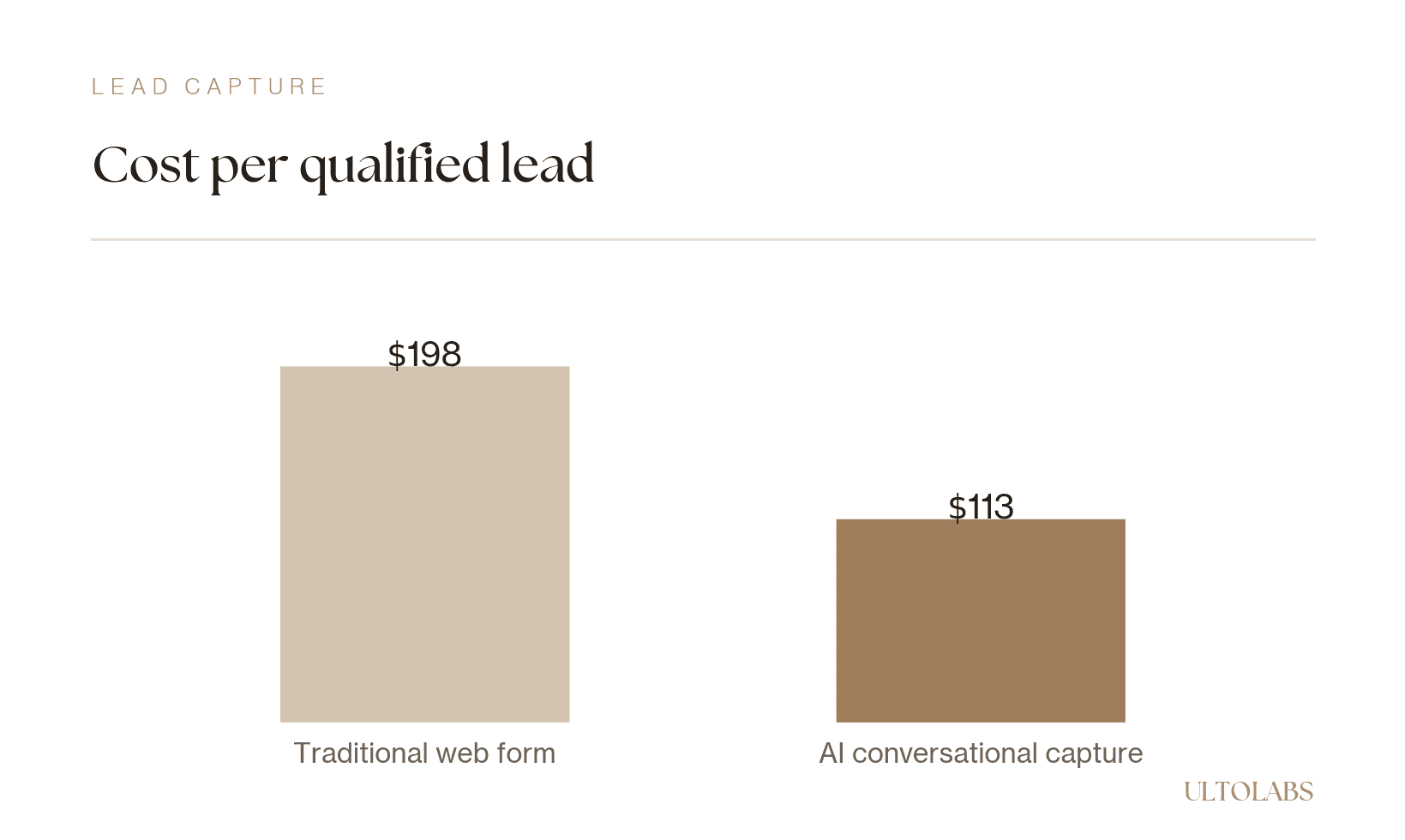
AI qualification lowers cost per qualified lead versus forms (industry research, 2025).
Why Is Bilingual Capture Essential in the Middle East?
Bilingual capture is essential because Middle East visitors engage in Arabic and English, and a capture tool that handles only one loses the visitors who prefer the other. Language is part of the friction, and removing it lifts capture directly.
A visitor who is greeted and helped in their preferred language engages more readily and shares details more willingly. One who has to switch languages or struggle feels the friction and leaves, exactly like a cold form. Bilingual capture meets every visitor where they are, which widens the share of traffic you can convert.
This is not a minor localization detail. In a market where a single site serves Arabic-first and English-first visitors, and many who move between both, monolingual capture caps your conversion below what your traffic could deliver. Bilingual AI capture removes that cap. UltoWeb's tools engage and capture in both languages by design.
How Do You Maximize Capture From Existing Traffic?
You maximize capture by replacing static forms with integrated conversational tools, qualifying as you capture, and routing leads instantly into the pipeline. This gets more from the traffic you already pay for, which is cheaper than buying more.
Start where the traffic already lands: your highest-intent pages. Replace the passive form with an AI conversation that engages, answers, qualifies, and captures. Connect it to the CRM so leads flow straight into your workflow. Make it bilingual so no visitor is filtered out by language. Then measure capture rate, lead quality, and cost per qualified lead against the old form.
The gains come without a bigger ad budget, because you are converting more of the visitors you already have. That is the advantage of capture optimization: the same traffic, several times the leads. Once capture is maximized, additional ad spend produces far more return, because the site it feeds actually converts.
Frequently Asked Questions
What is AI lead capture for websites?
It is a set of integrated tools that engage visitors in conversation, answer their questions, qualify them, capture their details, and route the lead into your CRM. It replaces static forms with an active exchange, converting more of the same traffic into qualified leads.
How much more can AI capture convert?
Conversational capture typically converts several times the rate of static forms and produces better-qualified leads, lowering cost per qualified lead. The exact lift depends on your traffic and pages, but the improvement over cold forms is consistent across industries.
Does it replace my contact form entirely?
It can, or it can run alongside it. Many firms replace forms on high-intent pages with conversational capture while keeping a simple form as a fallback. The goal is to remove the friction that causes most visitors to abandon a cold form.
Are captured leads sent to my CRM automatically?
Yes, when the tools are integrated properly. A qualified lead flows straight into your pipeline, routed and ready, so a rep can act while intent is high. This is the difference between an integrated capture system and a widget that just collects emails.
Conclusion
You already pay for the traffic. A static form throws most of it away by demanding effort before giving value. Integrated AI lead capture reverses that: it engages first, qualifies as it captures, and routes leads into your pipeline, in Arabic and English. Converting several times more of your existing traffic is cheaper and faster than buying more of it.
UltoWeb's chatbot tiers deliver this as integrated capture, not a bolted-on widget. Replace the forms on your highest-intent pages, connect capture to your CRM, and turn the traffic you already have into qualified pipeline.
Sources: McKinsey GCC AI, retrieved 2026-07-10. Conversion and cost-per-lead figures reflect widely cited 2025 industry research.